Tuesday, July 9, 2013

A Regional Canadian Food: Hodge Podge

I really wasn't sure what regional food I should write about, so last week, I asked my many expat friends what Canadian foods they miss. The answers were really interesting (and might provide ideas for future posts). Along with many, many varieties of junk food for savoury and sweet cravings, here are some of the things that were listed:
- for the Prairie folks: Taber corn (the super-sweet corn grown in Taber, Alberta), saskatoons, Alberta beef, green onion cakes, pierogies, cabbage rolls
- for the maritimers: seafood (crab cakes, fish cakes, scallops, mussels, lobster), Hodge Podge, blueberry grunt, donairs
- butter tarts, Nanaimo bars, cucumber / sweet pickles, maple syrup


Hodge Podge

Wednesday, July 3, 2013

The Slow Movement and Privilege

Privilege is problematic.

It keep us divided from each other by cocooning us in invisible comfort. Inside its walls, it is easy to assume that everyone lives as we live and thinks as we think. It whispers that anyone who is Not Like Us must not be trying hard enough. It is the nice guy explaining in the comment section that men should be welcomed to the women-only bicycle ride. It is your employer not giving the woman in the next cubicle more responsibilities, because she's just going to leave the company when she gets pregnant. It is your grandparents saying that racism no longer exists because there is a black president, and your kids' school only including the pre-contact life of first nations communities in their curriculum.

If you are reading this blog post, that means that you are part of a tiny fraction of humanity who can read and have internet access. Bloggers and social media users tend to forget that we are a subculture within that tiny fraction of humanity. We are so privileged.

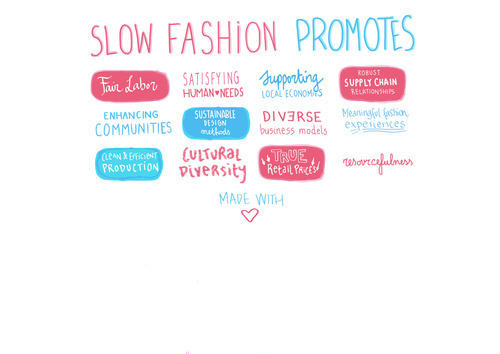
One of the most troubling problems in the slow movement is its lack of diversity. People who are talking about applying slow movement ideas to various disciplines - or who talk about environmentalism, or bicycle infrastructure advocacy, or any of a number of similar topics - are mostly over-educated white people like me. The slow home hashtag is used by architects and interior designers, and we tend to assume that home ownership is the norm. We need to talk about slow home for renters. Slow design is still a term mostly used by academics. The term slow travel is mostly being used by young people who travel - often college kids with the resources to travel around the world, or digital entrepreneurs who can work while travelling. The slow fashion hashtag often skews toward talk of luxury design, or things being custom-made - or on the flip side of that, being inexpensively handmade but with a huge time investment. The slow food movement is portrayed from the outside as being about expensive restaurant meals and overpriced farmers' markets and ridiculously time-consuming gardens, instead of being about good, clean, fair food that starts locally. Even minimalism, the most diverse of the related topics, is essentially a philosophy born of privilege - "too much stuff" is the ultimate first-world problem.

Even the conversation following the (brilliant) Salon post on Pollan's possible sexism and the issues of privilege in the slow food movement has tended to turn into arguments over feminism, or whether the DIY movement is actually disproportionately female, or comments pointing to worthy slow food projects being done in partnership with communities in need - instead of examining the critique that the ideas of the slow movement seem largely irrelevant if you lack the means or the time to adopt them. (Note that I said they *seem* irrelevant, not that they *are* irrelevant.)

"We Are Better Together" art print by Ello Lovey on Society6. LOVE this.
How do we broaden the reach of our conversations, and find ways to tell our stories and share our ideas outside our little subculture? How do we describe the ideas and projects of the slow movement for a different audience with different concerns? How do we answer - or acknowledge and address - charges of privilege or elitism? How do we include other cultural traditions in the mix without colonialism or cultural imperialism? How do we, to imperfectly borrow a term from feminism, create an intersectional slow movement?

There are no easy answers.

Maybe, we can make a start by acknowledging our privilege, and being mindful of it. We are lucky; we can use our privilege as a tool to help us make changes that those who haven't been as lucky might be unable to make alone. (And yes, if you dig a little deeper, 'luck' itself is a social construct that lets us feel more comfortable wearing our privilege, but that's another whole blog post.) If we create projects after careful consultation, charrettes, or co-design processes, we can make change *with* communities instead of *for* them, on their terms, with their trust and support and ingenuity. We are better together, and we can create brilliant things and elegant solutions by truly engaging with each other as equals in the design and planning process.

Also, perhaps we can make a start by taking our ideas out into the wider world. We can talk about the great things we can do on a limited budget, with limited time, with limited resources, or in different cultural contexts, but that does no good if we only end up talking to people like ourselves. We need to be engaging. We need to make our work relevant. We need to do more than academic papers and blog posts and art shows and conferences. We need to share our ideas through demonstration projects and street art and pop culture. We need to think big and scale up. We need to showcase brilliant projects and put conceptual designs into production and into peoples' hands.

Tell me: what else do you think we need to do to broaden the appeal and the usefulness of the slow movement?

Wednesday, June 26, 2013

Dyeing silk with blueberries, logwood, and onionskin

Time to make some end-of-schoolyear gifts for the kids' teachers! 

I started with a dozen 8m/m 11" x 60" Chinese habotai silk scarves. (I know, not at all local, but great for gift-giving and a nice size to allow me to experiment with different dyeing techniques.)

Sunday, June 23, 2013

Community Building: Throwing A Block Party

All the houses on our four-year-old cul-de-sac have now completed construction and been sold, so the timing is right to start a neighborhood tradition and make friends with the neighbours. At a Christmas get-together, the idea of a block party met with enthusiasm, so I decided to get the ball rolling and start the process. Once the idea was out there, several of my neighbours banded together as an informal planning committee, and things fell together easily.


Here's what we did:

Friday, June 7, 2013

My First Authentic Canadian Food Experience: Wild Nova Scotia Blueberries

This post is part of the Canadian Food Experience project proposed by my friend Valerie Lugonja, who is a board member of Slow Food Edmonton. The project began June 7th, 2013, and has a Facebook page. As we (participants) share our collective stories across the vastness of our Canadian landscape through our regional food experiences, we hope to bring global clarity to our Canadian culinary identity through the cadence of our concerted Canadian voice. Please join us. 

I grew up in Nova Scotia. My family were there for generations, going back to the early 1600s. My mother's side is a mix of Dutch-German "foreign Protestants" and English-by-way-of-Connecticut Planters who settled in the South Shore and the fertile Annapolis Valley. My father's people were English-by-way-of-Massachusetts Planters Loyalists (one was tried for recruiting for the British Army during the Revolution!) who forsake the land to become sea captains based on the Parrsboro shore and brought home their brides from England.

One of my earliest food memories is picking wild blueberries with my parents. Each tiny wild blueberry is an explosion of flavour, unlike the larger high-bush blueberries. We kids would just use our fingers to pick, and inevitably eat more than went into our buckets, while my mom supervised us and kept us entertained with stories of watching her colour-blind father pick whole buckets of green berries when she was a child. Dad did the bulk of the picking using an antique blueberry rake made of wood and tin shaped like this one:

blueberry rake, photo via eattheweeds.com

Thursday, June 6, 2013

DIY denim Bermuda shorts

This slow fashion tutorial is so easy, even I couldn't mess it up:

1. Take your formerly-favourite boot-cut or flared jeans that are suddenly looking tired now that everyone is wearing skinnies. (Or, someone else's that you scored at a thrift shop - look for good quality denim with no inside-the-thigh damage from wear.)

2. Cut them right above the knee. If your jeans are like mine, you'll be able to tell where that is without measuring because the knees are just a little worn - but you may also wish to measure along the inside of your leg from crotch to knee, mark that measurement on the inside-of-leg seam of the jeans using tailors' chalk, then cut. (Save the offcuts. You'll use them to creatively patch another favourite pair. I'm thinking I'll use boro embroidery as my inspiration for that project.)

(Want shorter shorts? Try measuring the inseam of a pair whose fit you love, then adding a couple of inches to give you room to roll the hem.)

3. Hem as desired. For now, I've just been rolling mine up to hide the raw edge. If yours won't stay rolled up, you can use iron-on hem tape, turn them in and hem, or bind the edge with a pretty ribbon.


4. Bonus points if the jeans were too small and you updated them by inserting a ribbon panel along the outside-of-leg seam. (I did this as a teenager, and I'm planning to use the trick for a couple of my daughter's favourite pairs to extend their life.)

Et voila! You now have a pair of the on-trend denim shorts that every shop seems to be flogging this summer - and you've extended the length of time you'll wear a favourite piece of clothing.

Thursday, May 9, 2013

Slow News Summary: Spring 2013

First slow news summary since February. Are you ready for all this link love?

On slow design, slow making, and slow home:

As expected, slowLab have relaunched their crowdfunding campaign on Indiegogo. Their end product will be the Slow Design Knowledge Platform (a web-based learning tool, community hub, and research incubator) - and their pledge rewards are absolutely the coolest. I've signed up for the collaborative Slow Design Reader and the ability to host a Slow Dialogue in my city (details to be announced soon!), but I'm also coveting the exquisite porcelain cups and wishing I had the cash to travel to their location and do an intensive workshop. Sigh. (BTW, if you were one of their supporters on Kickstarter, you should be aware that your credit card was never actually charged and that you need to repledge if you want to support them.) Oh, and if you happen to be in NYC for Design Week 2013, they're doing a brilliant HUMAN CHAIR project that you can participate in:


HUMAN CHAIR #slowhuman from slowLab on Vimeo.

On slow fashion:

On slow food:
On slow travel:
On slow living, slow parenting, slow money, and so forth:

On sustainability and environment:

The monarch butterflies are in trouble. Plant more milkweed! (If only the fix for the massive declines in honeybee populations was as simple to implement.)