Showing posts with label recipes. Show all posts

Sunday, December 8, 2013

A Canadian Christmas: mock cherry (cranberry) pie

I have no idea if this recipe is a Maritime food tradition, per se, but my Christmas holidays are incomplete without it, and it features one of the great wild foods of of eastern North America: the cranberry. Regional magazine Saltscapes have printed a version of it, attributing it to author Lucy Maud Montgomery, so I guess it has a little Canadian food cred. My Nana - my maternal grandmother - made it every Christmas, and now so do I.


This time I used organic fresh cranberries grown in Notre-Dame-de-Lourdes, Quebec, and a handful of leftover craisins along with the raisins. You can do this with frozen cranberries too, of course. The recipe from Saltscapes calls for chopped fruit, but I use the cranberries and raisins whole.

Pearl Lantz Schofield's Mock Cherry Pie Filling 

Sunday, November 24, 2013

Pearl Lantz Schofield's Pumpkin Pie recipe, made from scratch


Today we used my Nana's recipe to make pumpkin pie from a wonderful Riverbend Gardens pumpkin that was a gift from my friend Owen. It was scrumptious, although probably not special to anyone outside my family. Here's her recipe:

spice mix:
cinnamon 1 tsp
nutmeg 1/2 tsp
ginger 1/2 tsp
allspice 1/2 tsp
dash of salt

1 egg

1 cup pumpkin (fresh* or canned)

1 cup milk/cream blend
1/4 cup sugar (this amount seems low, don't you think?)
or, substitute 1 cup sweetened condensed milk for milk-sugar mix

Whisk all ingredients together and pour into a pastry pie shell. Bake 375F for 45-60 min, until the filling is firm.

*To prepare a fresh pie pumpkin: cut in half, scoop out the seeds, roast the flesh 350F for 1h, let cool, and puree. For more details (and a delicious-looking fancier alternate recipe!) check this terrific post out. 1 pie pumpkin (the little smooth ones) will usually yield enough for two pies.

Wednesday, November 6, 2013

Harvesting and Preserving: Green Tomato Mincemeat

This post is part of the Canadian Food Experience project (also on Facebook) proposed by my friend Valerie Lugonja, who is a board member of Slow Food Edmonton. The project began June 7th, 2013. As we (participants) share our collective stories across the vastness of our Canadian landscape through our regional food experiences, we hope to bring global clarity to our Canadian culinary identity through the cadence of our concerted Canadian voice. Please join us. 

My October was bananas, thanks to municipal election madness over at the Local Good's blog, so this month you'll get a two-fer: my preserving post and my harvest post, all in one. A childhood harvest memory that I cherish, and hope to recreate next year here in Edmonton, is having such a bounty of tomatoes from my mother's garden that we couldn't possibly eat them all. Usually, Mom planted three different varieties: a cherry tomato for salads, a plum tomato, and one other. I remember the flavours but not the names - I'll have to ask her which cultivars they were (update: Mom says she planted the Beefeater and Scotia cultivars). There would be big brown paper bags of them lined up on the windowsill over the sink, to induce them to ripen, but inevitably we'd need to use them up before they all had a chance to get red. So, it was always my maternal grandmother's Green Tomato Mincemeat recipe to the rescue. It makes a wonderful pie filling, and since there is no actual meat in it, it's suitable for vegetarians and vegans.


Photo via Rhubarb & Honey who shares a very similar recipe!
Pearl's Green Tomato Mincemeat

3 pounds (10 cups) green tomatoes
3.5 pounds apples (Gravenstein apples would have been used)
2 cups brown sugar
1 pound seeded raisins
1 pound seedless raisins
1 tbsp salt
1/2 cup oil
1/2 cup cider vinegar
3/4 cup apple juice
2.5 tbsp cinnamon
2 tbsp cloves
1 tbsp nutmeg
2 lemons, grated and juiced

Cut tomatoes in quarters and blend; drain.
Add chopped apples (not peeled!) and other ingredients except lemon juice.
Cook slowly 2-3 hours adding apple juice as required.
Add lemon juice just before bottling.
Can be frozen or canned.

(Sorry, no photo - I haven't had a chance to make this yet! I'll edit this post to add photos as soon as I can, but I wanted to share the recipe right away.)

PS: Oooh, look, Valerie posted her green tomato mincemeat recipe too, with the most mouthwatering photos. Her proportions and spices (candied ginger!) are a bit different from my Nana's, be sure to compare them!

Saturday, September 7, 2013

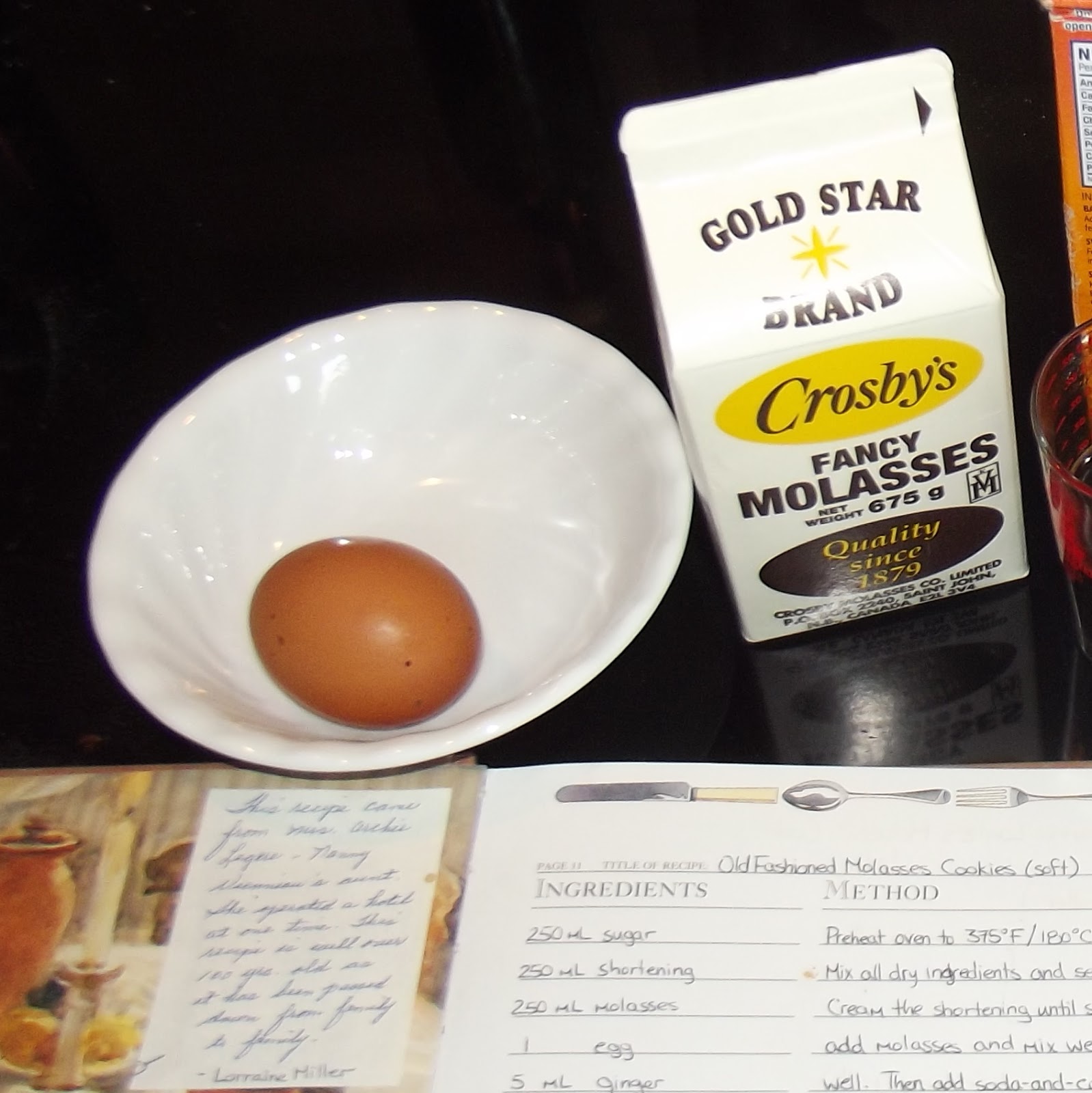
My Cherished Canadian Recipe: Old-Fashioned Molasses Cookies

While I have lived in Edmonton since 1994, I grew up in Nova Scotia, in a family that has been in that part of the world for generations. I've mentioned my family background before, a mishmash of South Shore German and Swiss, Annapolis Valley English-via-Connecticut Planters, Parrsboro-area English-via-Massachusetts Loyalists, and a series of adventurous brides who crossed The Pond from England to make new lives with dashing sea captains. The recipe I'll share today comes from my husband's family. His dad's people were English sailors who stayed in Halifax when their time in the Navy ended, and Gaelic-speaking Scots whose families came to Cape Breton during the Highland Clearances; his mom's folks are Acadian French who found refuge in the wilds of New Brunswick and married Quebecois families after the Expulsion. (Some early Acadian families are also Metis by blood, although records are so scarce that mitochondrial DNA tests are often the only evidence, and the Metis families were integrated into Acadian culture, instead of developing a distinct culture as happened on the Prairies.)


Molasses was a kitchen staple in the Maritimes as a result of the trade triangle between the Caribbean, Nova Scotia, and Great Britain. We shipped timber out - or turned the timber into sailing vessels - and the ships returned laden with molasses from the sugarcane plantations. (Rum is the favoured distilled alcohol of the Maritimes for the same reason.) For more on the history of molasses as a Canadian food, check out this great post from Bridget Oland from earlier in the Canadian Food Experience series.

This soft molasses cookie recipe is a family favourite that is now at least 120 years old. It came from Mrs. Archie Legere, an aunt of my husband's Acadian grandmother, who operated a hotel at one time (at least, according to the notes in the margin of the recipe card made by my husband's Aunt Lorraine Miller). I believe it originally would have been made with butter instead of shortening, and been written with imperial measurements instead of the metric provided by Aunt Lorraine (who was a high-school home economics teacher). 


Wednesday, August 7, 2013

A Canadian Food Hero: Chef Craig Flinn

Full disclosure: I've known Craig since high school in Dartmouth, Nova Scotia, when we sang together in the choir. He's a funny, easy-going guy with a rich, deep singing voice. But for today's Canadian Food Experience assignment - to choose our Canadian food hero - I chose Chef Craig Flinn because his dedication to cooking with fresh, seasonal, local food and celebrating Canada's rich, varied culinary heritage was my first real exposure to slow food. His first cookbook, Fresh & Local, remains one of my favourites after years of use, and his other books get regular use in my kitchen at home. If you're visiting Halifax, his trio of restaurants on Barrington Street - Chives Canadian Bistro, Ciboulette Cafe, and newly-opened lunch spot Two Doors Down - are an absolute must. While Craig is one of Nova Scotia's culinary stars, he's not as well known as he really ought to be outside of the Maritimes. Let's change that.
photo courtesy of Chef Craig Flinn (via his Facebook feed)

Tuesday, July 9, 2013

A Regional Canadian Food: Hodge Podge

I really wasn't sure what regional food I should write about, so last week, I asked my many expat friends what Canadian foods they miss. The answers were really interesting (and might provide ideas for future posts). Along with many, many varieties of junk food for savoury and sweet cravings, here are some of the things that were listed:
- for the Prairie folks: Taber corn (the super-sweet corn grown in Taber, Alberta), saskatoons, Alberta beef, green onion cakes, pierogies, cabbage rolls
- for the maritimers: seafood (crab cakes, fish cakes, scallops, mussels, lobster), Hodge Podge, blueberry grunt, donairs
- butter tarts, Nanaimo bars, cucumber / sweet pickles, maple syrup


Hodge Podge

Friday, June 7, 2013

My First Authentic Canadian Food Experience: Wild Nova Scotia Blueberries

This post is part of the Canadian Food Experience project proposed by my friend Valerie Lugonja, who is a board member of Slow Food Edmonton. The project began June 7th, 2013, and has a Facebook page. As we (participants) share our collective stories across the vastness of our Canadian landscape through our regional food experiences, we hope to bring global clarity to our Canadian culinary identity through the cadence of our concerted Canadian voice. Please join us. 

I grew up in Nova Scotia. My family were there for generations, going back to the early 1600s. My mother's side is a mix of Dutch-German "foreign Protestants" and English-by-way-of-Connecticut Planters who settled in the South Shore and the fertile Annapolis Valley. My father's people were English-by-way-of-Massachusetts Planters Loyalists (one was tried for recruiting for the British Army during the Revolution!) who forsake the land to become sea captains based on the Parrsboro shore and brought home their brides from England.

One of my earliest food memories is picking wild blueberries with my parents. Each tiny wild blueberry is an explosion of flavour, unlike the larger high-bush blueberries. We kids would just use our fingers to pick, and inevitably eat more than went into our buckets, while my mom supervised us and kept us entertained with stories of watching her colour-blind father pick whole buckets of green berries when she was a child. Dad did the bulk of the picking using an antique blueberry rake made of wood and tin shaped like this one:

blueberry rake, photo via eattheweeds.com