Showing posts with label slow food. Show all posts

Thursday, January 1, 2015

Family Recipe: White Sugar Cookies

I had the pleasure of attending the annual Slow Food Edmonton sugar cookie bake on Candy Cane Lane this holiday season. From our host Cynthia, I learned two tricks for baking sugar cookies: roll them out with extra icing sugar (instead of flour) on the countertop to keep the dough from getting too dry, and use a sil-pat sheet to keep them from sticking to the cookie sheet. Seriously, the sil-pat worked like magic, but parchment paper works almost as well.

Cynthia has a snail-shaped cookie cutter. THE CUTEST.
This is the recipe I made in advance to bring with me: the classic "white sugar cookie" recipe that came to me from my husband's grandmother, Delma (nee LeBlanc) Vienneau, via his aunt Lorraine (Vienneau) Miller. We're not sure how old it is. Aunt Lorraine also had adapted the recipe, so I'll append her version to this post. This is the doubled original recipe.

4 cups sifted wheat flour (I use half unbleached all-purpose, and half organic "soft white" flour from local growers Gold Forest Grains)
2 cups white sugar
2 tsp baking powder
1 tsp cream of tartar
1/2 tsp salt
2 eggs
2 tsp vanilla
1 cup butter

Preheat over to 350F / 180C.

Sift then measure flour. Add baking powder, cream of tartar, and salt to flour.

In another bowl: cream the butter until soft and smooth. Add while mixing: sugar, vanilla, eggs, then flour mixture (a bit at a time).

(The dough can be chilled or frozen - or used right away.)

Roll on a lightly floured board to about a quarter-inch thick and cut into desired shapes. Bake for 10 or 12 minutes. You may sprinkle with sugar before baking if desired - or decorate with icing once cooled.


Aunt Lorraine's adapted sugar cookie recipe:

3 cups flour
1 cup sugar
2 tsp. cream of tartar
1 tsp. baking soda (not baking powder!)
1 tsp. salt
2 eggs
1 tsp. vanilla
3/4 cup shortening (instead of butter or margarine)
1/4 cup milk

Combine dry ingredients (except sugar).
Cream shortening until soft. Add while mixing: sugar, eggs, vanilla.
Add 1/4 of flour mix, mix well, then add 1/2 of milk and mix well.
Add 1/2 of remaining flour, mix well, add rest of milk, mix, then add rest of flour and mix until all traces of flour disappear.
If dough is too soft to handle, add extra flour.
Roll to about 2 cm thick, cut and bake 10-12 minutes at 350F / 180C.


Friday, June 20, 2014

My Canadian Food Voice, and Wild Saskatoon Grunt

This post is my final entry of the Canadian Food Experience project (2013-2014) (also on Facebook) proposed by my friend Valerie Lugonja, who is a board member of Slow Food Edmonton, with the goal of sharing regional food experiences to clarify our Canadian culinary identity. THANK YOU, VAL! Please check out the blogs of the other participants, and watch Val's blog for ongoing quarterly roundups of Canadian Food Experience posts for phase two of the project. 


via
I'm not a food blogger. I'm not even a proper capital-b-Blogger with a single focus and a daily or even weekly writing practice; I write intermittently, as the mood and topic tickles my fancy, and my photography skills are indifferent at best. I write to please myself. That anyone else reads my posts is a source of constant astonishment.

So, writing monthly posts for the Canadian Food Experience challenge over the past year stretched me, in the best ways, and helped me to clarify my voice as a writer and explore my interest in the slow food movement. 

Wednesday, May 7, 2014

The Canadian Kitchen Garden: USDA Zone 3

This weekend is the Victoria Day long weekend, which Edmontonians usually consider the beginning of the frost-free season and safe to plant seedlings, and things are finally starting to green up - so my thoughts have turned to establishing my kitchen garden. 

(September 7th update: skip to the bottom of the post for photos from the end of the season!)


happy bee on an Evans Cherry sapling in bloom at the garden centre
I grew up in Nova Scotia (USDA Zone 5ish), but all my gardening as an adult has been in Edmonton (USDA zone 3, which you can push to zone 4 in protected microclimates). The cottage-style garden I made at my last home was purely decorative, with an emphasis on peonies, iris, hostas, and daylilies. I am sorely missing the now-mature Evans Cherry tree we planted in that garden, and the gorgeous sour cherry gelato I made from its fruit. Sigh.


my little raised bed from last summer needs rebuilding already
However, two summers ago we moved house to a larger lot, and so this summer's labour of love is turning the bare bones planted by the previous owners into a proper kitchen garden.

Wednesday, April 9, 2014

Another Regional Canadian Food: Donald Merriam's fish chowder and Solomon Gundy

In my last regional Canadian food post, I noted that my Maritime ex-pat friends missed all manner of seafood. This one is for them: my grandfather's chowder recipe, a classic fish-and-potato chowder that is easily adapted to whatever seafood you can get fresh or frozen locally. In my case, I'm using grocery-store seafood that has been flash-frozen while fresh, because I live on the Prairies. It's not possible here to ask your fishmonger how old their stock is, and have them look at their watch.

Port Greville harbour circa 1910, via Dan LeBlanc's flikr stream. That's my grandparents' home, where my Dad grew up, with the upstairs bedroom windows open in the lower right corner.
Workers at Wagstaff & Hatfield Shipbuilding, Port Greville, Nova Scotia, probably sometime in the 1960s. My grandfather Donald Merriam is the fellow third from right in the front row, squinting at the camera. The big red house on the hill at left was built by his father. Via Dan LeBlanc's flikr stream.
My father's dad was a sailor, from a long line of merchant seamen of Planter ancestry (the New Englanders who were shipped in to settle the land after the Acadians were deported). He sailed two- and three-masted schooners along the trade routes of the Atlantic before World War Two. He served in the engine room of motor gun boats after training as a motor mechanic during the war, then applied that skill to work in a shipyard on the Parrsboro shore of the Bay of Fundy. He had very impressive blackwork tattoos from his sailing days on his forearms, gone blue and a bit blurry with age; at least one was the anchor that he would have gotten after his first Transatlantic voyage on a schooner. At the tender age of four he made me solemnly promise to never get a tattoo, because he'd always regretted having them as an adult. I also remember him taking me out on the Bay in a dory to jig for flounder once when I was a kid - he never repeated the adventure, because apparently I couldn't sit still and he was terrified that I would fall in and drown.

My grandfather in his Canadian Navy dress uniform (I think) during World War 2. I believe this was taken in London when he and my grandmother got engaged or married - there is one of her to match.
Cream-soup chowders are a landlubber's luxury. This chowder was served aboard ship on cargo schooners, where fresh milk was not available, and even adding canned milk would have been unlikely and is optional (but my mom always did, so to me, it doesn't taste right without it). The fish used would have been cured with salt and smoke and packed for the voyage, or caught fresh.

For those of you who like to compare recipes before you make your own version, my grandfather's chowder recipe is similar to this milk-based recipe from Cubits, and Chef Michael Smith's version grates the potatoes and adds white wine.

Tonight's version, made with bacon, scallops, and halibut. It tastes almost like I remember.
I'm out of summer savoury so I substituted a bit of dill.
Donald St.Clair Merriam's fish chowder 
(as told to my mother shortly after she and my father got married)

bacon (or, originally, salt pork)
white fish, filleted: cod / haddock / halibut / flounder / sole
potatoes, peeled and cubed
1 onion, diced
1 carrot, diced (optional)
1 stalk celery, diced (optional)
water
spices: summer savoury, salt and pepper to taste
1 can evaporated milk (optional)

Cook bacon, chopped up. Sautee the chopped onions in the bacon fat with bacon. Add potatoes (and carrot and celery) to the soup pot and add water immediately to cover. Bring water to boil, then turn down to medium-low. Cook covered 10 minutes, then add fish. Cook covered until fish is cooked (10 minutes per inch of fish). Add 1 can evaporated milk and spices at end. Best served with tea biscuits or scones.

My modifications:
(1) I add scallops, too, because I love them. They get sauteed in the bacon grease until cooked, then reserved, and added back into the pot just before serving.
(2) Instead of leaving the bacon in the soup pot, I prefer to cook it until crisp, reserve it, then crumble it and some dulse over the bowl when serving.
(3) My mom prefers to leave the bacon out, and sautee the chopped onions in butter instead of bacon fat, which is likely how it would have been done when brined pork was used.
(4) Sometimes, like today, I don't peel my potatoes. I thought the red skins would look pretty.

Bonus recipe! This one is exactly as written in my paternal grandmother's handwriting. I haven't tried it, and my parents don't remember him making it, but when I was a teenager, Grampie had converted a small shed into a smokehouse, so he probably made it to use up his salt-cured smoked herring. It's served as an appetizer with crackers, sometimes with cheese and another pickle. My maternal grandmother's father also made Solomon Gundy - which is emphatically not said "Solomon GRundy" like in the nursery rhyme.

Don's Solomon Gundy (pickled herring)

Cut herring into bits.
Soak overnight if salt.
Next day mix equal amounts of vinegar & sugar, enough to cover fish, in saucepan.
Add small bag of pickling spice & boil. Let cool; pour over fish after packing in bottles with layer of fish, layer of onions.

If this recipe is unclear, try this version. The history of Solomon Gundy is discussed here. You might be more familiar with Solomon Gundy as the spicy fish paste from Jamaica - same stuff, but with no sugar and more heat in the spice mix, and pureed.

This post belatedly fulfills Challenge 10 (from March) of the Canadian Food Experience project (also on Facebook) proposed by my friend Valerie Lugonja, who is a board member of Slow Food Edmonton. The project began June 7th, 2013. As we (participants) share our collective stories across the vastness of our Canadian landscape through our regional food experiences, we hope to bring global clarity to our Canadian culinary identity through the cadence of our concerted Canadian voice. Please join us. 

Sunday, December 8, 2013

A Canadian Christmas: mock cherry (cranberry) pie

I have no idea if this recipe is a Maritime food tradition, per se, but my Christmas holidays are incomplete without it, and it features one of the great wild foods of of eastern North America: the cranberry. Regional magazine Saltscapes have printed a version of it, attributing it to author Lucy Maud Montgomery, so I guess it has a little Canadian food cred. My Nana - my maternal grandmother - made it every Christmas, and now so do I.


This time I used organic fresh cranberries grown in Notre-Dame-de-Lourdes, Quebec, and a handful of leftover craisins along with the raisins. You can do this with frozen cranberries too, of course. The recipe from Saltscapes calls for chopped fruit, but I use the cranberries and raisins whole.

Pearl Lantz Schofield's Mock Cherry Pie Filling 

Sunday, November 24, 2013

Pearl Lantz Schofield's Pumpkin Pie recipe, made from scratch


Today we used my Nana's recipe to make pumpkin pie from a wonderful Riverbend Gardens pumpkin that was a gift from my friend Owen. It was scrumptious, although probably not special to anyone outside my family. Here's her recipe:

spice mix:
cinnamon 1 tsp
nutmeg 1/2 tsp
ginger 1/2 tsp
allspice 1/2 tsp
dash of salt

1 egg

1 cup pumpkin (fresh* or canned)

1 cup milk/cream blend
1/4 cup sugar (this amount seems low, don't you think?)
or, substitute 1 cup sweetened condensed milk for milk-sugar mix

Whisk all ingredients together and pour into a pastry pie shell. Bake 375F for 45-60 min, until the filling is firm.

*To prepare a fresh pie pumpkin: cut in half, scoop out the seeds, roast the flesh 350F for 1h, let cool, and puree. For more details (and a delicious-looking fancier alternate recipe!) check this terrific post out. 1 pie pumpkin (the little smooth ones) will usually yield enough for two pies.

Wednesday, November 6, 2013

Harvesting and Preserving: Green Tomato Mincemeat

This post is part of the Canadian Food Experience project (also on Facebook) proposed by my friend Valerie Lugonja, who is a board member of Slow Food Edmonton. The project began June 7th, 2013. As we (participants) share our collective stories across the vastness of our Canadian landscape through our regional food experiences, we hope to bring global clarity to our Canadian culinary identity through the cadence of our concerted Canadian voice. Please join us. 

My October was bananas, thanks to municipal election madness over at the Local Good's blog, so this month you'll get a two-fer: my preserving post and my harvest post, all in one. A childhood harvest memory that I cherish, and hope to recreate next year here in Edmonton, is having such a bounty of tomatoes from my mother's garden that we couldn't possibly eat them all. Usually, Mom planted three different varieties: a cherry tomato for salads, a plum tomato, and one other. I remember the flavours but not the names - I'll have to ask her which cultivars they were (update: Mom says she planted the Beefeater and Scotia cultivars). There would be big brown paper bags of them lined up on the windowsill over the sink, to induce them to ripen, but inevitably we'd need to use them up before they all had a chance to get red. So, it was always my maternal grandmother's Green Tomato Mincemeat recipe to the rescue. It makes a wonderful pie filling, and since there is no actual meat in it, it's suitable for vegetarians and vegans.


Photo via Rhubarb & Honey who shares a very similar recipe!
Pearl's Green Tomato Mincemeat

3 pounds (10 cups) green tomatoes
3.5 pounds apples (Gravenstein apples would have been used)
2 cups brown sugar
1 pound seeded raisins
1 pound seedless raisins
1 tbsp salt
1/2 cup oil
1/2 cup cider vinegar
3/4 cup apple juice
2.5 tbsp cinnamon
2 tbsp cloves
1 tbsp nutmeg
2 lemons, grated and juiced

Cut tomatoes in quarters and blend; drain.
Add chopped apples (not peeled!) and other ingredients except lemon juice.
Cook slowly 2-3 hours adding apple juice as required.
Add lemon juice just before bottling.
Can be frozen or canned.

(Sorry, no photo - I haven't had a chance to make this yet! I'll edit this post to add photos as soon as I can, but I wanted to share the recipe right away.)

PS: Oooh, look, Valerie posted her green tomato mincemeat recipe too, with the most mouthwatering photos. Her proportions and spices (candied ginger!) are a bit different from my Nana's, be sure to compare them!

Monday, September 30, 2013

Cider 101 with Shovel & Fork

On Sunday, I got to take a cider-making course with Chad and Kevin from Shovel & Fork. Lucky me! If you are in or near Edmonton, you need to check them out - they do all kinds of fantastic skill-sharing courses, from kitchen gardening to butchery. With their permission, I'm sharing a few photos from the course. Naturally, for the complete details, you really ought to sign up the next time this is offered.

We started the rainy morning with a quick chat about fruit choice, then some of us picked apples from Kevin's tree, while the rest worked at the fruit crushing station and cut the larger apples. Those are adapted garburators that we're using to crush the fruit. You can also go old school and use a 4x4 and a bucket. Don't used a steam extraction juicer, which cooks all the great flavours out of the juice.

Saturday, September 7, 2013

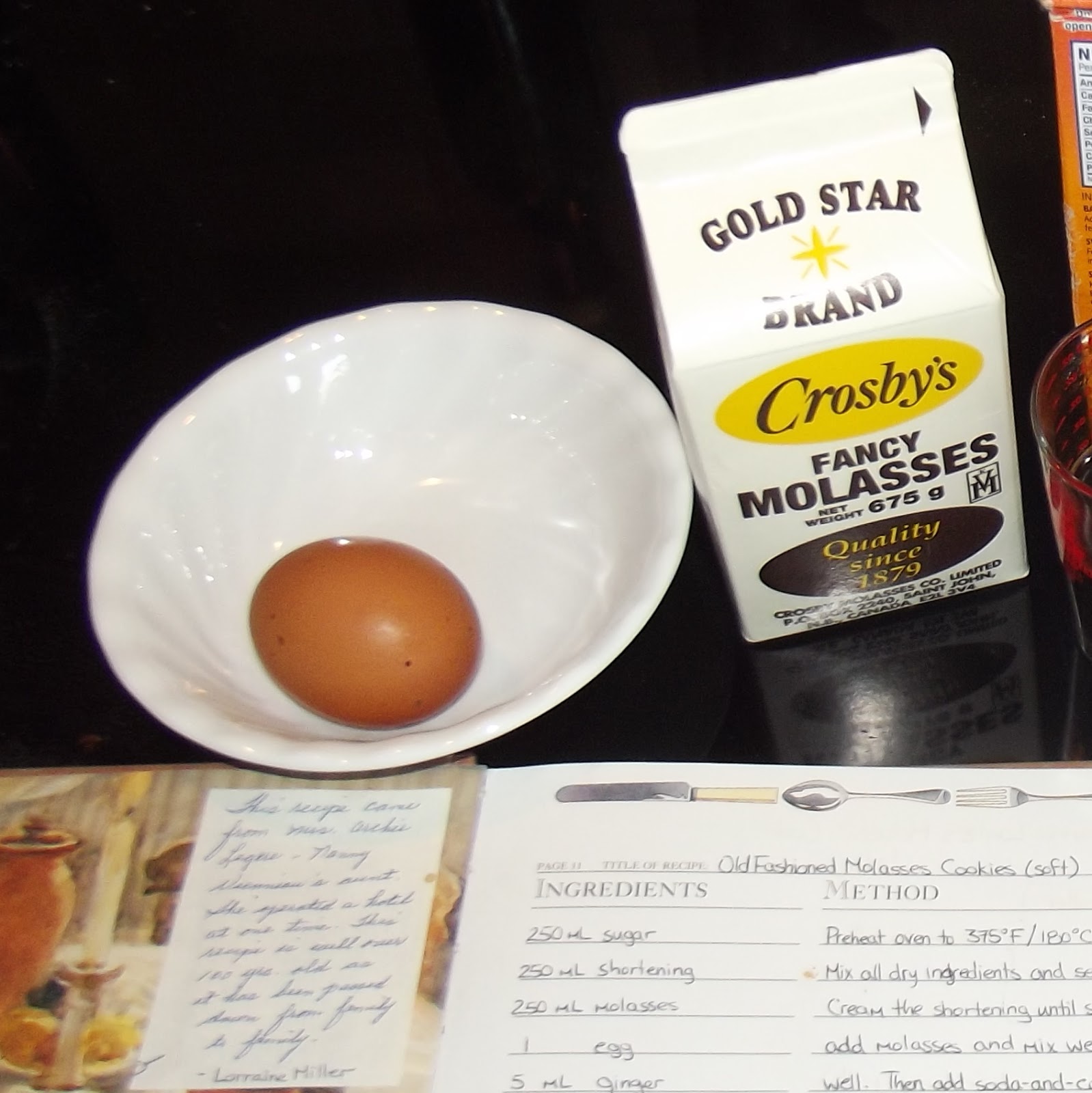
My Cherished Canadian Recipe: Old-Fashioned Molasses Cookies

While I have lived in Edmonton since 1994, I grew up in Nova Scotia, in a family that has been in that part of the world for generations. I've mentioned my family background before, a mishmash of South Shore German and Swiss, Annapolis Valley English-via-Connecticut Planters, Parrsboro-area English-via-Massachusetts Loyalists, and a series of adventurous brides who crossed The Pond from England to make new lives with dashing sea captains. The recipe I'll share today comes from my husband's family. His dad's people were English sailors who stayed in Halifax when their time in the Navy ended, and Gaelic-speaking Scots whose families came to Cape Breton during the Highland Clearances; his mom's folks are Acadian French who found refuge in the wilds of New Brunswick and married Quebecois families after the Expulsion. (Some early Acadian families are also Metis by blood, although records are so scarce that mitochondrial DNA tests are often the only evidence, and the Metis families were integrated into Acadian culture, instead of developing a distinct culture as happened on the Prairies.)


Molasses was a kitchen staple in the Maritimes as a result of the trade triangle between the Caribbean, Nova Scotia, and Great Britain. We shipped timber out - or turned the timber into sailing vessels - and the ships returned laden with molasses from the sugarcane plantations. (Rum is the favoured distilled alcohol of the Maritimes for the same reason.) For more on the history of molasses as a Canadian food, check out this great post from Bridget Oland from earlier in the Canadian Food Experience series.

This soft molasses cookie recipe is a family favourite that is now at least 120 years old. It came from Mrs. Archie Legere, an aunt of my husband's Acadian grandmother, who operated a hotel at one time (at least, according to the notes in the margin of the recipe card made by my husband's Aunt Lorraine Miller). I believe it originally would have been made with butter instead of shortening, and been written with imperial measurements instead of the metric provided by Aunt Lorraine (who was a high-school home economics teacher). 


Wednesday, August 7, 2013

A Canadian Food Hero: Chef Craig Flinn

Full disclosure: I've known Craig since high school in Dartmouth, Nova Scotia, when we sang together in the choir. He's a funny, easy-going guy with a rich, deep singing voice. But for today's Canadian Food Experience assignment - to choose our Canadian food hero - I chose Chef Craig Flinn because his dedication to cooking with fresh, seasonal, local food and celebrating Canada's rich, varied culinary heritage was my first real exposure to slow food. His first cookbook, Fresh & Local, remains one of my favourites after years of use, and his other books get regular use in my kitchen at home. If you're visiting Halifax, his trio of restaurants on Barrington Street - Chives Canadian Bistro, Ciboulette Cafe, and newly-opened lunch spot Two Doors Down - are an absolute must. While Craig is one of Nova Scotia's culinary stars, he's not as well known as he really ought to be outside of the Maritimes. Let's change that.
photo courtesy of Chef Craig Flinn (via his Facebook feed)

Tuesday, July 9, 2013

A Regional Canadian Food: Hodge Podge

I really wasn't sure what regional food I should write about, so last week, I asked my many expat friends what Canadian foods they miss. The answers were really interesting (and might provide ideas for future posts). Along with many, many varieties of junk food for savoury and sweet cravings, here are some of the things that were listed:
- for the Prairie folks: Taber corn (the super-sweet corn grown in Taber, Alberta), saskatoons, Alberta beef, green onion cakes, pierogies, cabbage rolls
- for the maritimers: seafood (crab cakes, fish cakes, scallops, mussels, lobster), Hodge Podge, blueberry grunt, donairs
- butter tarts, Nanaimo bars, cucumber / sweet pickles, maple syrup


Hodge Podge

Friday, June 7, 2013

My First Authentic Canadian Food Experience: Wild Nova Scotia Blueberries

This post is part of the Canadian Food Experience project proposed by my friend Valerie Lugonja, who is a board member of Slow Food Edmonton. The project began June 7th, 2013, and has a Facebook page. As we (participants) share our collective stories across the vastness of our Canadian landscape through our regional food experiences, we hope to bring global clarity to our Canadian culinary identity through the cadence of our concerted Canadian voice. Please join us. 

I grew up in Nova Scotia. My family were there for generations, going back to the early 1600s. My mother's side is a mix of Dutch-German "foreign Protestants" and English-by-way-of-Connecticut Planters who settled in the South Shore and the fertile Annapolis Valley. My father's people were English-by-way-of-Massachusetts Planters Loyalists (one was tried for recruiting for the British Army during the Revolution!) who forsake the land to become sea captains based on the Parrsboro shore and brought home their brides from England.

One of my earliest food memories is picking wild blueberries with my parents. Each tiny wild blueberry is an explosion of flavour, unlike the larger high-bush blueberries. We kids would just use our fingers to pick, and inevitably eat more than went into our buckets, while my mom supervised us and kept us entertained with stories of watching her colour-blind father pick whole buckets of green berries when she was a child. Dad did the bulk of the picking using an antique blueberry rake made of wood and tin shaped like this one:

blueberry rake, photo via eattheweeds.com

Sunday, October 16, 2011

Slow Food: A Baker In The Family

One of the great rewards of baking for yourself is knowing exactly what ingredients are in your food; you can choose organic, unbleached, whole-grain, and locally-grown flours. You can compensate for special dietary needs, like our household's need to be completely peanut- and nut-free. You can get adventurous and experiment with loaves usually not found at your local bakery.

pretzels
rustic whole grain sourdough loaf
garlic and French onion ciabatta
whole wheat cheese and mustard loaf
green tea sweet buns

If you're as lucky as I am, you have a partner who does it for you, just for fun, every weekend, and the only drawback is the occasional need to clean sourdough snot starter out of the sink. My husband finds it relaxing and is becoming fairly accomplished as a baker, as you can see from the photos above of his work. He's particularly proud of his green tea sweet buns, which were inspired by the ones we ate on our trip to Japan and adapted from a regular bread roll recipe, and the pretzels, which took him forever to perfect. His beer pretzel recipe was posted on his blog a while back.
Today is Blog Action Day 2011, and the topic is food - not slow food, but hunger and famine. I'm not going to write extensively about it; I just wanted to express gratitude for how extraordinarily fortunate we are as North Americans when it comes to our food security. We are blessed to even be able to nitpick over where our food comes from. I also wanted to point out that the slow food movement isn't as divorced from food insecurity as you might think, and link out to a few great posts from today.

{Food insecurity is defined magnificently in the Red Cross UK video in this BAD11 post - please go watch it. 
Agencies like the Red Cross who are working to increase the resilience of at-risk communities need our unwavering support.} 

By growing and making your own food, and supporting local farmers and CSAs and farmers markets and grocery delivery services, and going to locally-owned restaurants where the chefs specialize in local ingredients, you actually help to ensure the food security of your community should hard times ever come. You help to control the global rise in food prices. Also, by reducing the amount of food you are importing from elsewhere, you reduce your food's carbon footprint. By supporting slow food projects in other communities - like the projects championed in this blog post - you bring those benefits to developing and at-risk nations. Choosing slow food is a small step in the right direction, but cumulatively our choices can make a huge difference.