Showing posts with label vintiques. Show all posts

Thursday, September 13, 2012

Slow Living: The Hunt

You may have noticed that when I write about my wardrobe or my decor, or even my bicycles, I end up using the words "thrifted", "vintage", and "antique" a lot. I love the variety and sense of history that older objects bring to a space or an outfit. I love that antiques are green. I love hunting for them, learning about them, and using them. I love the stories that they tell.

While I've never joined a collectors' club, I've been a casual collector of antiques and vintage since before the days of eBay (oops, I just outed myself as old, didn't I?). Now that my kids are both in full-time school, I'm able to spend more time on The Hunt, so I thought it would be neat to make summaries of the cool things I've found a semi-regular feature on the blog. I'm going to include things found at thrift shops, antique malls, or on Kijiji since all three of those are dominated by vintage and nearly-new items in my city.

Here's what I've scored in the last couple of weeks:

The folding plywood chair by American Seating that I told you about yesterday.
Pyrex bowls, a fluted Fire-King bowl, and a small Pyrex casserole - all $5 each at Value Village -
because borosilicate is best.
A china creamer souvenir of Whitehorse, Yukon; a GourMates by Glo-Hill mid-mod chrome serving platter;
and a Birks house brand silver-plate tray to go with my silver-plate tea set. All from Value Village.
Also, for my wardrobe (no photos because I sent most of these things for dry cleaning):
- two wool pencil skirts and one linen tulip skirt
- two lace-trimmed black polyester camisoles from the '80s
- one white cotton button-up blouse

I'm doing the link party thing for the first time, so please be gentle with me. Today I have linked up with Simple Design's Thrift Haul (well, I will when the next one goes live on Monday - meanwhile check out her 5 rules of thrifting) and Cap Creations' Thrifty Love.

Wednesday, September 12, 2012

A vintage folding plywood chair

Look what I found at a local antique mall yesterday!


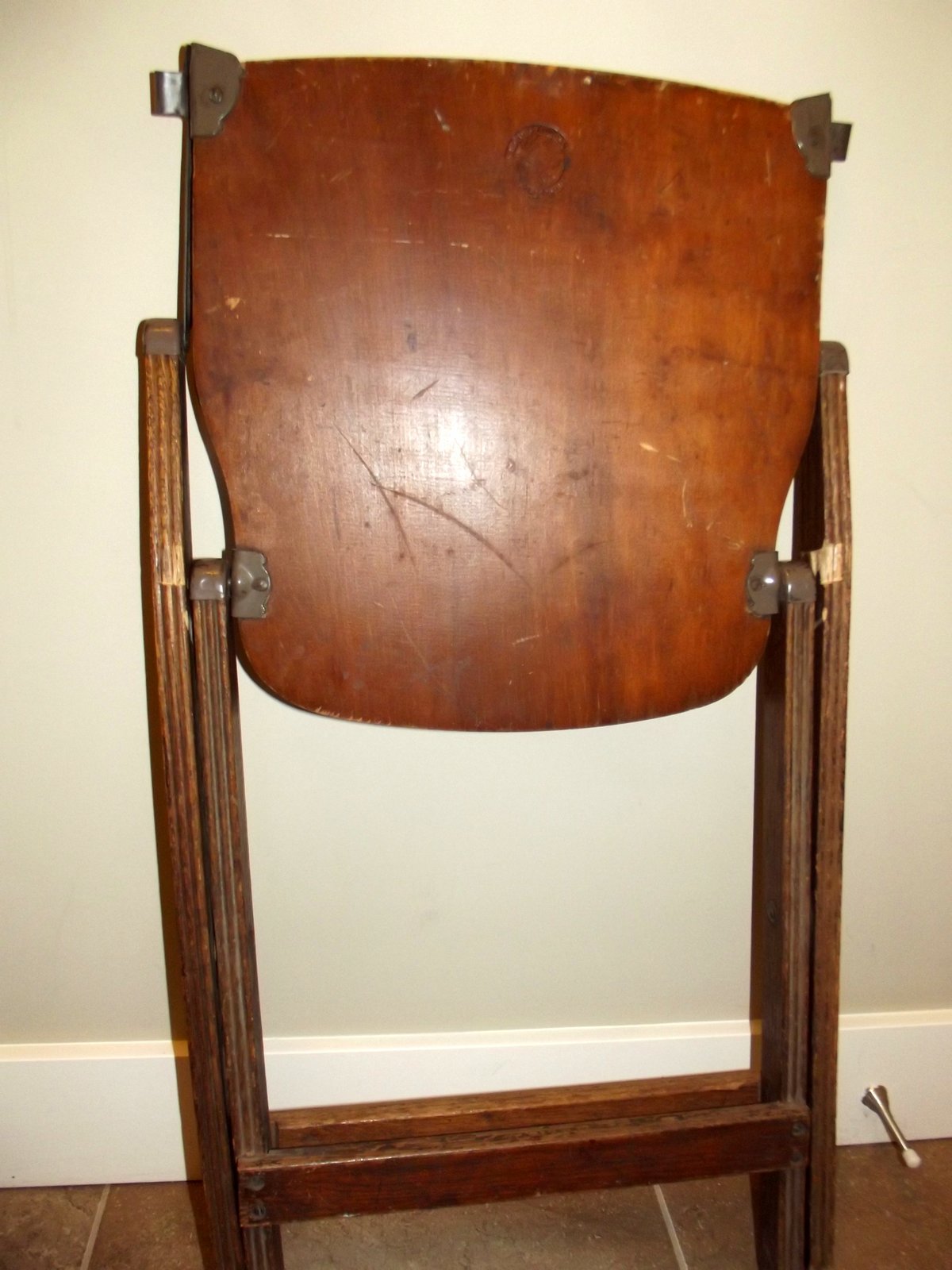
I was drawn to this wonderful folding chair by the transitional nature of its design, which combines moulded plywood with quarter-sawn oak and sturdy industrial metal hinges. The tag said it was a steamship deck-chair, but I knew that wasn't the case at a glance.
It folds beautifully and compactly, with an unusual and elegant mechanism.  Here it is mid-fold. 
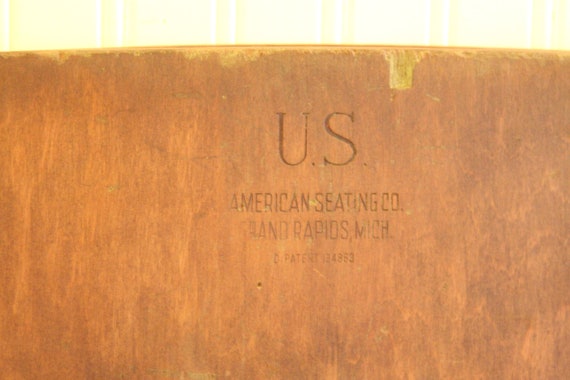
Completely folded and flipped over to show the underside of the seat with the maker's stamp.

The stamp tells me it was made by American Seating Company, Grand Rapids, Michigan,
who are still in business (in the same location even!) today.
Is that the ghost of an ink-stamped S that I see under the stamp?
The version of the mark on my chair was in use from 1931-1956. In the PDF history of the company, a photo of a similar chair is labelled as a World War Two folding chair circa 1941; they were simultaneously making millions of steel folding chairs for the military. Many of the similar wood folding chairs from American Seating that have ended up for sale on the internet seem to have come from schools and churches rather than the military.

Here is a sibling wartime wooden folding chair on Etsy, with an identical shape and hinges, and a giant U.S. stamp on the back instead of the round stamp (and remnants of inked identification) mine has:
Via Etsy listing for a chair almost identical to mine, which must date to 1943-1945.
The patent number on that chair's stamp leads me to this patent, applied for in 1941 and granted in 1943, and the name of the chair's designer, Walter E Nordmark (who must have worked at American Seating as an industrial designer because there are several other American Seating design patents with his name on them). My folding chair, with no patent number, might be a wartime chair that predates the patent being granted (1941-1943), but could also be a postwar chair (1945-1956) if the round stamp was applied without the patent number stamp to chairs sold to schools and churches.

From 1939-1941, Charles Eames taught at Cranbrook Academy of Art outside of Detroit, Michigan. I can't help but wonder whether Nordmark was a student or colleague of Eames, and whether this elegant folding design was part of a larger conversation in the design community about plywood use that culminated in the creation of the Charles & Ray Eames' famous LCW.

The finish on this chair is really dinged up, with signs of water damage on the seat, which is why it was only $68. Now that I've determined that it isn't a rare item, I feel okay about refinishing (in a way that doesn't erase its history) and sealing the surface so I can use it beside the tub in the ensuite without damaging it further.