Monday, July 18, 2011

1000 Items Decluttering Challenge

I love that Daryl from Vermont Cottage has given herself a "countdown to simplicity" challenge, to get rid of 1000 items from her home this year. She says she got the idea from the 100-things-a-month challenge at the now-defunct Simple Living Network (not to be confused with the currently-en-vogue minimalist 100 Thing Challenge from Dave Bruno). There are still people posting about the challenge on that website's cousin, the Simple Living Forums - search on 'decluttering' and you'll find them. There are lots of other decluttering challenges out there, but I really like the simplicity of this approach. As a mom with kids of a certain age, I always have a box or a bag going that's collecting stuff to donate to Goodwill or Salvation Army or whoever, anyway, but keeping track of the numbers online could be a great motivator.

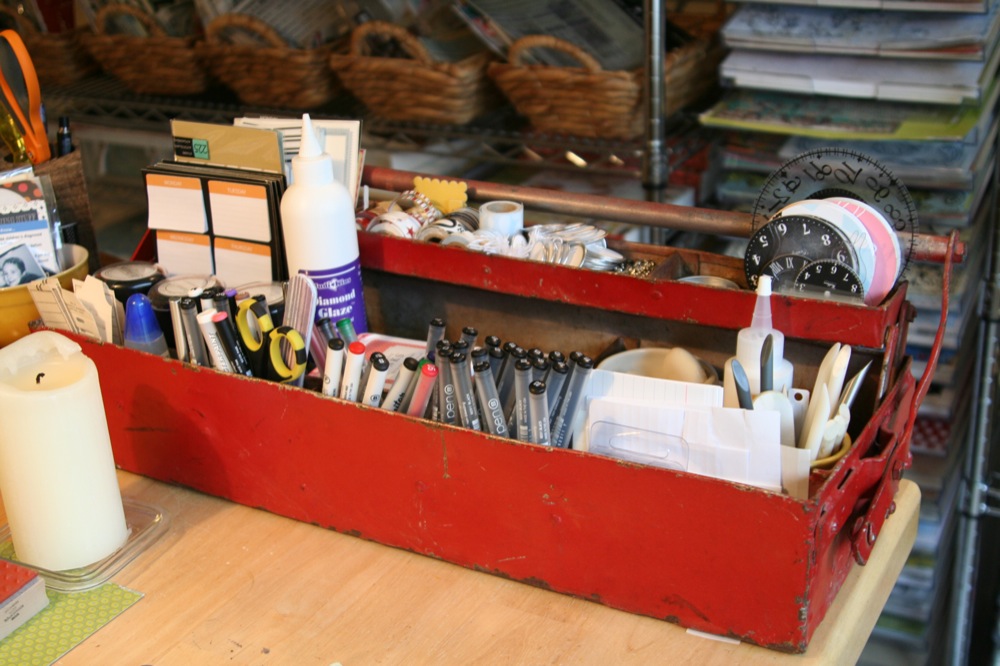
Maybe I'll get it together enough to have a studio that looks like this. Via: Ali Edwards on Flikr.

For my purposes, I'll not count consumables or paper as part of my item count. I have ridiculous amounts of paper to purge, as if it multiplies when the lights are off, and even with a 20 sheets = 1 item clause I'd get to 1000 before my home office was cleared out. I'd also rather focus on items that take up more psychic and visual space than a box of old papers, at least at this stage of the game.

I'm going to let myself count things that are leaving because they're being replaced - but I'll also subtract the number of items purchased. Hopefully I won't ever end the month with more items purchased than donated. =P

Oh, and for now, books will get a free pass, since (a) you can never have too many books, (b) we did a huge bookshelf purge a couple of years ago when we built-in bookshelves in our office/library open space, and (c) we're mostly buying digital editions these days.

Rather than waiting til the start of next month, I'll start counting from today. You'll be able to watch my progress in the box in the sidebar, and from time to time I'll do an update post to talk about what's working for me, what isn't, and which things I find I have real trouble letting go of.

Monday, July 4, 2011

(S)low Tech, Japan, & Azby Brown's "Just Enough"

Bicycles are the ultimate example of slow tech. Tokyo, May 2011.
There are two definitions of Slow Tech floating around out there. The first definition is a relatively recent buzzword about slowing down your electronic communications and slow blogging, limiting your time spent online, and writing letters or emails instead of tweeting or texting. 

An older definition of Slow Tech has to do with choosing simple, low-technology solutions over higher-technology solutions. Complexity can be a double-edged sword: a high-tech tool may save time, energy, or resources during its production, but it may also be quicker to break, more difficult to repair, or too expensive to be within reach for all but affluent end-users. A low-tech tool is usually hand-crafted, more durable, and inexpensive.

Slow Tech, and the related 1970s term 'Appropriate Technology', is an idea that's finding a lot of currency in the design world, both in the contexts of developing countries and the transition movement (the idea that developed nations need to move beyond our current dependence on fossil fuel in preparation for increasing fuel scarcity). Designers heap praise on the rare new designs that show a combination of practicality, durability, repairability, and affordability - particularly when they show potential to change lives in developing nations, as do the Q Drum, the D Light and Nokero solar lamps, and Design That Matters' Car Parts Incubator. Design and decor bloggers return time and again to classic products and time-tested solutions that share slow tech qualities, like bicycles, Moleskine notebooksTrombe walls, and Swiss Army knives

When you think of modern Japan, you probably think of the neon-covered skyscrapers of Tokyo
Shinjuku, May 2011: many signs are still turned off to save electricity in the wake of the 3/11 earthquake and tsunami.
and gadgets like the Toto Washlet toilet seat found in place of more traditional squat toilets in most hotel and public washrooms.
Luckily by the time we saw this example we had figured out ones that were also labelled in English.
Not very low-tech or slow, right? Yet we saw a lot of clever, slow technology in use during our trip to Japan. Bicycles are everywhere you look, most of the time configured to carry some combination of children and/or cargo.
A classic mamachari parked outside a cleaning-supply shop in Kyoto.
A delivery trailer attached to a bicycle with electric assist in Tokyo.
To cope with summer heat and killer humidity, folding fans and hand towels are used by everyone from schoolchildren to salarymen, and women usually carry a parasol or wear wide-brimmed hats to protect their skin from the sun instead of slathering themselves with sunscreen lotions.

Crossing a vermillion-painted bridge on a sunny late May day in Kyoto.
At the Hida No Sato outdoor museum in Hida-Takayama, we saw a shishi-odoshi, a simple water-operated gadget constructed from wood or bamboo that strikes a rock to scare wild boars away from the crops,
It operates a bit like a see-saw; smaller ones made of bamboo are often found in Japanese decorative gardens.
tools made of wood or ceramic that use a repeated thorn shape to grate foods,
You can still buy small ceramic graters for ginger that follow this design in kitchen specialty shops.
and tears in paper screens repaired by gluing overlapping paper petals to cover the hole for a solid, strong, aesthetically pleasing patch.
Can you see the flower-shaped patch on the paper shoji screens covering the closets in this tatami room?
The glue on these patches on an exterior screen has started to mildew, but they're still strong.
Ancient temples still have huge centrally-placed rain barrels and stacks of buckets as fire-fighting equipment.
These ones are at the Asakusa Kannon Temple in Tokyo.
For more examples I highly recommend you take a look at Azby Brown's brilliant book Just Enough: Lessons In Living Green From Traditional Japan. It's a fascinating account of life in Japan during the late Edo period. It's a densely written book with an academic bent, and incredibly thorough, with charming hand-drawn illustrations and notes in the margins. I'd definitely recommend it as a worthwhile read for anyone who is interested in permaculture, natural and sustainable building, small-space architecture, or Japanese history.

After reading Part I, Field and Forest, on the lives of rural people engaged in agriculture and forestry, I had a much richer understanding of the artifacts and architecture I saw at Hida No Sato and in the older quarters of Kyoto and Hida-Takayama, the agricultural practices and irrigation canals and human-modified ecosystems I had caught glimpses of as we sped past them on Shinkansen and tour buses, the daily rural life depicted in the background of Miyazaki's anime masterpiece My Neighbor Totoro, and even the uniquely consensus-based style of decision-making that modern western observers of Japanese politics and business describe as equally fascinating and frustrating. By the end of Parts II (The Sustainable City) and III (A Life Of Restraint), about the lives of commoners and samurai in Edo (Tokyo) itself, I was full of admiration for the internal courtyards and multiuse rooms and deep eaves still common in Japanese homes outside Tokyo, which must help immensely to make homes livable in the stifling heat and humidity of the rainy season, and much less confused by the block layout in modern Japanese cities.

However, the real point of the book isn't to make sense of modern Japan for tourists like me, but to call attention to the many ingenious solutions and strategies developed in Japan as a response to intense population pressures and resource scarcity could be brought to bear in a modern world facing similar challenges. The author also wrote a great essay for Design Observer, and did a talk for TEDxTokyo to discuss these strategies:


As Brown says, the crucial strategy underlying most of the innovations of pre-industrial Japan was that people looked for solutions that solved multiple problems at once ('multiform solutions'), and so designs were expected to live up to a number of requirements:
 Can this be done without consuming fuel (like weaving)? Can it be made from a rapidly renewed material (bamboo for baskets, or reeds for thatch)? Can it take advantage of recycled material (a broken iron pot becomes a blade)? Is it scalable and able to be customized to suit specific regions, households or individuals (like kimono)? What is the desired degree of durability — is it better to make it last for generations (like cabinetry) or remade every year (like straw boots)? Is there a way to use the material at end-of-life (use the straw as fuel, convert worn cotton fabric to pouches)? In most cases, these requirements were never spelled out in cost-versus-benefit calculations, but were inherent assumptions for Japanese of that period. Design questions were invariably viewed in the context of their implications for the wider environment and for sustaining the lifestyle indefinitely into the future.
This observation gets to the heart of the requirements for modern sustainable design, too. Perhaps, instead of lusting after shiny green gadgets, we should be looking more carefully at slow tech solutions: simple, practical, durable, repairable, affordable, and sustainable.

Let's use the comment section to brainstorm more slow tech solutions, to help each other find new slow tech to incorporate into our lives. Tell me: what's your favourite slow tech object?
Saturday, July 2, 2011

Fashion Diet Reflections

My first stint of Project 333 has wrapped, although truthfully I've been wearing a hybrid of my while- in-Japan list and my updated rest-of-the-90-days list for the past couple of weeks. Maybe because I'd allowed myself a different wardrobe with a completely different colour palette during my trip, or maybe because I had trial-run my list for nearly a month before starting, I found it very difficult to stick with my 33 items for the final few days. Both the monotony and the need to handwash so many of my items were really getting to me. Rather than fight that, I decided I'd experiment with what my next list might look like, ditching the winter-spring items and bringing out my summer stuff in light of the hot weather we've been having.

That said, I think a slow fashion Project 333 list is still totally doable, either if your items are carefully chosen for easy care, or if you're childless and the handwashing routine fits your schedule. I'll be aiming for the former as I amend my list of items.

I also made a couple of additional changes to my list during my final month. I bought shorter trench coat on sale, more suitable for cycling in, and swapped it in in place of the white trench coat. Here's a photo of me in it from the Critical Lass ride report on my other blog. I still haven't finished sewing my LBD so I subbed in a black wrap LBD in its place, and I still hadn't worn one of my skirts more than twice so I subbed in a polkadot one in its place. I happen to be wearing those in this photo too, with my rubber boots and black tights.


Here's what I learnt about myself during my first Project 333 stint:

  • I need to have easy-to-launder items for my core everyday wardrobe, because my lifestyle doesn't allow me to hand wash things all the time. 
  • My personal style tends toward casual, vintagey, and artsy. I basically live in tops with interesting details and either jeans (or shorts) and flats or a skirt layered over leggings with knee-high boots. I almost never wear dress slacks, and limiting my wardrobe choices does not change that tendency. 
  • As someone who frequently makes her own jewelry, I really chafed at not being able to change the look of an outfit with a different set of accessories - even if most of the time I wear the same signature items.
  • I photograph much better in navy than in black.

All in all, I loved doing Project 333 - it gave me a great framework for figuring out my personal style and my wardrobe needs, and I'm looking forward to doing it again. However, rather than doing Round 2 of Project 333 right away, I took a look at the many other fashion diets out there, and I'm going to try a 30-for-30 Remix Challenge instead. (Follow the link to Kendi Everyday for all the details on how to do it yourself - Kendi has written a cunning workbook that I kind of wish I had read before starting Project 333.)

I like the simplicity of the 30-for-30 Remix Challenge idea: take 30 items, make 30 outfits, with no time frame or other rules. You can choose to not shop during the challenge, if you wish. If an event comes up, you can take a day off of the challenge and wear something outside your list, although you might not want to. Shoes are included in your 30 items, but not outerwear or accessories, which has the potential to be a real monotony-killer and make it easier to transition the outfits that come out of the challenge between seasons. The emphasis in 30-for-30 on creating different looks by remixing what's in your closet also appeals to me. During my first Project 333 I tended to get stuck in a rut and only wear my items one way, so the challenge to find ways to wear my clothes differently will help to shake me out of that rut.

I haven't made my list of 30 items yet, but think I will keep some of my Project 333 rules going during my 30-for-30, as well. I won't count undergarments, pajamas, lounge wear, or workout clothing as part of my list. I'll keep my Bonus Rule #1, of letting myself swap out items for very similar items as the seasons change, although outerwear not being part of the list will mean I don't need to use that option much. I'll continue to strive to bring the slow-fashion cred (Bonus Rule #3) by including as many handmade, local, sustainable, second-hand, or vintage items as possible. Bonus Rule #2 won't be needed since I'm not planning any trips to exotic destinations. That I know of.

I am also adding a 4th Bonus Rule that I cannot buy anything that isn't on my need-to-buy list at the beginning of the 30-for-30 Remix Challenge - and that anything on my need-to-buy list should be part of the 30 items. No shopping FTW!

Friday, July 1, 2011

Monthly Slow News Summary: July 2011

Happy Canada Day! And of course Independence Day for our friends in the States. So many great news stories have come up, I thought I'd forego my usual mid-month timing for this and share some long-weekend reading with you now.


On Slow Design and Eco Products:

The Living Principles reported on a marvelous project in Zurich in which young designers collaborate with seniors to create new products and teach a new generation older skills and techniques. Brilliant!

Jorg & Olif reported on some bamboo products that don't rely on chemical processing to make viscose.

EcoSalon rounded up the latest green kitchen appliances. I'll have the induction cooktop, please.

Could commercial-scale urban agriculture in greenhouses designed using permaculture principles be in our future? Sure. Meet the Polydome.

On Slow Food:

The current President of Slow Food USA did a short video interview for GenConnect describing the slow food movement.

Here's a fascinating report from a Slow Food international meeting of Indigenous food communities. Imagine how much richer that conversation will be when representatives whose travel visas were denied for financial reasons are able to attend!

On Slow Fashion:

As SlowFashioned's Jessica explains, Slow Fashion is not anti fashion, it's high-quality fashion that transcends time or place. (Hmm, I'm not sure I agree about place - local materials and artisan traditions are an important part of all facets of the slow movement. But if she means choosing flexible clothing items you'll be able to wear anywhere life takes you, sure.)

Recycled Fashion asked: is slow fashion a threat to high-street fashion retailers? (I think so.)

The Green Stylist profiled the UK's DIYcouture, who are publishing a series of slow-fashion instruction manuals to help you make your own classic clothes, even if you're a total newcomer to sewing.

Bamboo introduced their readers to the principles of slow fashion.

Here's a local story from the Edmonton Journal about the unworn clothes in our closets.

After awhile, Project 333 becomes second nature.

On Slow Living:

The Slow Food masterminds in Italy are releasing a statement of principles for Slow Medicine on June 29th. Can't wait to see the actual document released by Petrini and his team, but meanwhile here are additional articles about the approach, pioneered in geriatric care by Dr. Dennis McCullough.

The Globe & Mail reported on the slow pleasures of collaborative board game Settlers Of Catan.

New coblogger Leah Moss shared her thoughts on her Slow Home on SlowMama.

Matt from Tortoise Knows Best reviewed Rob Westwood's e-book 'Simplify'.

Zoe from SlowMama did a guest post about Slow Parenting on Zehlahlum Family.

Create The Good Life! wrote about how the principles behind improv can help bring spontaneity and creativity into your life.

There is a Slow Information Technology Manifesto now, aimed at IT consultants; it mostly talks about ways to manage the vendor-client relationship so that demands on IT consultants become less unreasonable. More helpfully for the rest of us, TED curator Chris Anderson has proposed some new rules of email etiquette.

On Slow Travel:

You should check out The Art Of Slow Travel, written by Denise Pulis - I suggest starting with her amazing What Is Slow Travel? post.

Looking to disconnect from your usual routine with an outdoor holiday? Lisa Borden did a great ecotourists' camping checklist for HuffPo Canada, and Jorg & Olif made some suggestions for enjoying outdoor festivals in eco style.

Here's a story from Norway about a nationally televised slow-travel voyage.

The Winding Way mused about how it seems many rural English pubs now cater to visitors instead of locals.

Vagabondish did a brilliant post on how to have a slow-travel experience when your time is at a premium. (We used most of these strategies for our trip to Japan, so I can vouch that they work!)

EcoSalon tempted us with sustainable resorts in Bali and the Tyrolean Dolomites.

On Sustainability:

Here's a thought-provoking article on what's wrong with green marketing, and how to fix it. Couple that with these 8 lessons from Sustainable Brands 2011 for more to mull over.

Transition Voice reviewed a new book on Urban Homesteading that looks flat-out inspiring. There's an electronic edition so you can read it on your smart phone or tablet.

Finally, there's a brilliant in-depth article in Rolling Stone on how propaganda originating from certain industries is poisoning the public discussion of climate change. You just might have heard of the author.

Monday, June 27, 2011

Slow Living: 'Tangled' Birthday Party Crafts

Yesterday we had a mostly-handmade birthday party for my eight-year-old.

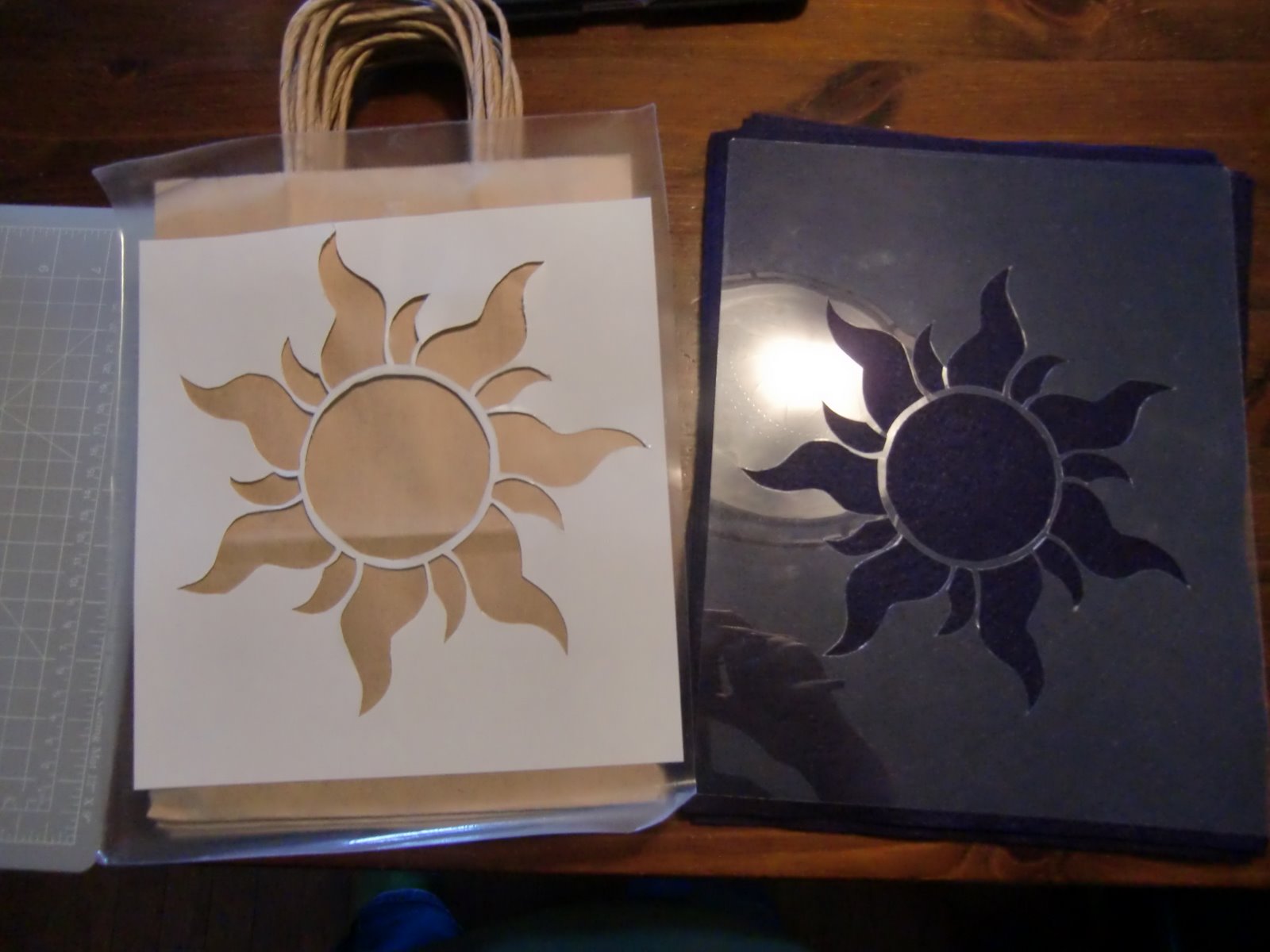
She wanted a party based on recently-released Disney film Tangled. None of the local party places have any toys and decorations for that film (one shop told me that they'd sold out of what they had because the movie is so popular; another said their ordering cycle hadn't caught up to films that recent yet). So naturally I turned to other bloggers to see what they'd done. Then I adapted some of the ideas (links are provided as we go) by turning a template for the sun design into a stencil, which I used to add metallic gold suns to recycled-polyester felt pennant flags and recycled-paper goody bags. (Naturally, this technique can be used for any design that's appropriate for stencilling.)

Here's how I made my stencil:

I printed the sun template (provided with this instruction video for how to make lanterns like those in the movie), and followed the instructions with this self-seal lamination kit to laminate the printout.


Then I used an exacto knife and a self-sealing cutting mat for the finicky work of cutting the design out. (I held off having my morning coffee until after I had done this, since a steady hand was required.)

Since the printout was cold-laminated, I could separate the sides when I was finished, so that I had two stencils. The stiff plastic side was best for my purposes, but depending on your design you might be able to use the thinner, more flexible side as well.

For stenciling on felt, I found that the felt was so thirsty that I didn't need to adhere the stencil to the surface (for instance, when you stencil a wall, repositionable spray glue is usually used); I could just lay the stencil on top of the felt and use a pouncing motion with a foam brush. (Don't forget to put something under your felt to protect your tabletop, since it's porous enough that paint will go right through it in places.)

As you can see, the acrylic paint I was using bled under the edges of the stencil a little, but not much. The results look pretty old-world.

Because I was running out of time, I added some tiny slits to the top edge of each sheet of felt and threaded a ribbon through the slits to hang the pennants for the party - but I will be hand-sewing them in place for a prettier, more durable finish before we hang them in their permanent home above the childrens' garden.

I also stenciled the goody bags, which used less paint and more of a brush-stroke application. The edge-bleeding on a paper surface was much worse than on the felt...

...so with my daughter's help, I outlined the edges with purple acrylic paint.

The finished goody bags. Our young party-goers each got a movie tie-in sticker storybook and stickers, a 'dreams' journal, a tree frog toy (shh, it looks like a chameleon), a skipping rope (because we played a 'Rapunzel's Hair Jump' skipping game) or a pirate sword (that looks like it might be Flynn's), and an apple from Maximus the horse, along with some little candies. If it had been less windy at the picnic, we also would have sent everyone home with a Pascal blow-out that they'd made.

We had a heart-shaped cake decorated with a small toy Rapunzel and Flynn in a gondola,

home-made cupcakes decorated to look like Pascal the Chameleon (or in the case of the blue ones with white gumdrop eyes, Cookie Monster),

sun-shaped home-baked bread served in a cast iron pan (thanks to my lovely friend Angel, who also made little paper-bag lanterns with LED candles inside), a plate of sliced cheese, trays of fresh fruit and vegetables, a bowl of apples,


and orange boats with felt sails floating on blue gelatin. Each hull in this case is half a mandarin orange.


We also played pin-the-pan-on-Flynn (using double-stick tape on the back of pan printouts cut out by the kids). In retrospect we should have made a bigger Wanted poster for that game!

We had our party at a local park with a huge playground and spray park, so there was lots for the kids to do in addition to the games and colouring we had planned - which is just as well since it was too windy and overcast for several of our ideas. 

Afterward my daughter announced it was the "best party EVER!", so... mission accomplished!

Lesson: if you're planning a themed party, do a search to see what other people have done before you run out and buy your supplies. Making something amazing for the party took me much less time than I spent hunting in vain through the party supply stores, and the results were much more special and meaningful, not to mention cost-effective!

Wednesday, June 15, 2011

On the Slow Home movement

I've written before about the principles of slow design, and my thoughts on the slow movement and the trend-driven worlds of decor and fashion. However, I haven't really talked about how the slow design principles are being expressed in the the realms of residential architecture, interior design, and decor through the Slow Home movement. Yvonne Blacker did a great summary post about six months ago on Alluminaire, and Slow Home has been a recurring source of inspiration at the brilliant, sumptuous decor blogs of A.B.C. Dragoo, Irene Turner, and Gloria Battista-Collins. I highly recommend that you spend awhile browsing through all three, as each of them have an incredible eye, and their takes on Slow Home style are very different.

So what does Slow Home mean to me?

It means that our dwellings and furniture should be carefully considered, because they have an enormous impact on our personal health and the health of the planet. Our homes should be grounded in the place where we live, using local materials and vernacular design, instead of interchangeable drywall boxes that could be in any city in the world. Our homes and furnishings should give us a feeling of coziness, timelessness, solidity, and permanence, instead of being disposable and trend-driven. Our decor should reflect our personalities and our family histories, and support our desire to live mindfully and creatively.

My Slow Home. July 2007.
My own home is in a walkable, bikeable suburb with a big back garden full of peonies and irises, a clothesline on the back deck, and wicker chairs on the front porch. We built it a little more than a decade ago now (affordability chose the location for us), insisting on extras like flat ceilings and  hardwood floors that improved on the small multilevel split's good bones and abundance of natural light. Over the subsequent years we've upgraded tile floors to ceramic, added a backsplash and moldings and beadboard and a french door, and built floor-to-ceiling bookshelves in the home office. We chose antiques and the occasional reproduction, decorated with collections and things made by hand, and grounded our love of rich colour with carefully chosen neutrals. We've ended up with a modern country look that's evocative of both a Prairie farmhouse and a Maritime saltbox... of where we are, and where we're from. All our decisions were made based on what we love, and what would make our lives more planet-friendly, not what might help the house to sell someday. Oh, and we had help from two children and two puppies in adding heaps of character (mostly in the form of toys and dings in the walls). It's cottagey, and lived-in, and since we're perpetually in the middle of decluttering or painting or picking up toys, I have very few 'finished' photos to share (I'll add taking proper photos of everything to my to-do list for this summer.).

The hand-stencilled brocade panels in the dining room were one of my first projects.
This is my daughter's third birthday, so this shot was taken about five years ago.
That's a walnut-stained farmhouse table under the cloth, and a rather bossy cherry-stained oak on the floor.
We've recently updated the room with aubergine faux-silk draperies and amethyst glass on the cabinet.
The kitchen right after the subway-tile backsplash was installed,
with part of my milk glass collection on the 'plant shelf' above.
The cabinets are the cherry-stained oak that was in vogue at the time we built.
These floor-to-ceiling shelves are in an open home-office space that overlooks the kitchen,
and are visible from the front entry of the house. My husband did an amazing job building them.
They're full of my reference books and shelter magazines, and my collections of Poole and McCoy pottery.
This might not be your version of a Slow Home; maybe for you, minimalist simplicity is the paramount expression of the slow life. Maybe fearlessly embracing your passion for bold pattern and colour is your path to authenticity in decorating. Maybe your Slow Home is a downtown apartment in a bustling metropolis, or a beachside surf shack, or a fifty-acre farm. Wherever you live, however you live, it is still possible to find ways to incorporate the Slow Movement into your home.

Won't you tell me what Slow Home means to you, and what makes your home slow?

16 June Edit: silly me. I forgot to mention that my inspiration in posting this yesterday was that today at 5pm EST / 3pm MST/ 2pm PST / 10pm GMT, we'll be talking about the Slow Home movement on Twitter's #DesignTV chat, hosted by A.B.C. Dragoo - who did another fantastic post on Slow Home today herself - and Jonathan Legate (whose swoonworthy tumblr is brimming with timeless design). You can join in by following the #DesignTV hashtag or using tweetchat. I'll post a link to the transcript afterward for those of you who missed it!


17 June Edit: Here's the transcript: http://www.curatede.com/Tweet/ChatTopic/DesignTV?topicid=297

Tuesday, June 14, 2011

Monthly Slow News Summary: June 2011

I've been home from my trip to Japan for a couple of weeks now, and I'm still getting over the insane jet lag and refining some blog posts from the trip. Meanwhile lots of interesting posts have emerged on aspects of the slow movement. In the interest of getting them up in a timely manner, I'll just do bullet point lists this month...


On Slow Food:


On Slow Travel:


On Slow Fashion:


On Slow Design:


On Slow Living:


On Sustainability: