Sunday, February 9, 2014

The #30DaysOfMaking Challenge, and a scarf (updated)

I need a push to start finishing some of my many works-in-progress, and to get myself into the habit of spending time in my studio every day, so I've decided I'm going to set a challenge for myself that starts today (my birthday!).

I'm going to make something - or part of something - every day, and I'm going to post photos to keep myself accountable.

A daily blog post feels like it would take too much time away from the creative process, so instead I'll tweet about it, and do an occasional summary post. People already tweet (and Instagram, and Tumblr, and all that jazz) using #whatImade #whatImadetoday and #workinprogress, but I thought it would be more fun if I created a hashtag for anyone to use who'd like to try such a challenge for themselves. Hence #30DaysOfMaking. Join me! The only rule is that you post a photo daily  for 30 days with the hashtag of something you are making by hand.

(April 4th Update: I quickly realized that 30 consecutive days is too ambitious for most people, myself included. This challenge is about sharing the joy of making, not about guilt! I also made a sidebar button for anyone who wants to join in - you can get that and see the updated rules here.)

Here's what I'm making today:
The Doctor Who fan club scarf pattern from the early 80s, republished here by PBS and also discussed in minute enough detail to warm any geek's heart at doctorwhoscarf.com.


Sunday, February 2, 2014

5 tips for using Pinterest for research

So, yesterday was Social Media Breakfast Edmonton's first all-day Camp, and I was invited to give an introductory talk on Pinterest. Fun, right?

Except that the day before, one of my kids and my husband both came home sick with some evil virus, and by the time I'd finished adding the screencaps to the slides at 9pm you could fry an egg on my forehead. No SMBYEG Camp for me! Sigh. Luckily, the organizers were able to recruit gorgeous, talented, and capable Genoa to fill in for me and read my slides with only 13 hours' prep time. I hear she was magnificent. She's my hero. 

Here are my Powerpoint slides imported into Prezi, if you'd like to take a look. (The format is a bit peculiar, and I'm still figuring out how to fix the transcript, which is currently only the text on the slides in random order. Completely useless if you want to know what was actually said.)
A lot of my talk went over the standard, ubiquitous getting-started tips (set a timer! don't just repin! leave comments! try the new map feature!) ...but there was a twist. My focus in my Pinterest use is on research and trend-spotting, not marketing, so over time, I've found that some of the standard tips for bloggers and small business owners just don't apply for users like me. 


(By the way, if you are a blogger or small business owner, I suggest that you check out these great posts about setting up your account and optimizing your blog for Pinterest, and look at the Viraltag and Octopin management tools in addition to Tailwind's analysis tool. Oh and the rules for running contests on Pinterest have just changed, so read the fine print before you follow any of the advice on contests.)

So, let's pull out of my talk the 5 best tips I have for using Pinterest as a research tool and visual resource, instead of a branding and marketing tool or shopping aid.

screencap of my boards on my profile page
1. Your filing system: If your goal is zillions of followers, enormous boards with hundreds of pins are supposedly a follower-magnet - but if you are using Pinterest for research, it becomes difficult to find the pin you're looking for. So, make your categories specific. I learned this the hard way: my crafty board quickly became utterly unmanageable, so I split it up. In its place, I currently have sewing, weaving, rug hooking, felting, natural dyeing, embroidery, knitting/crochet/tatting (which will likely get split), holiday crafts, and miscellaneous crafts boards. Plus a few that are for specific projects I'm working on, and some of which are secret boards (which are marvelous for those projects-under-development that you're not ready to unveil yet).

2. Following people whose pins inspire you seems like a no-brainer, especially if you're using Pinterest to inspire your art or learn more about relatively esoteric topics - but beyond your existing connections, how do you find more people who share your taste and interests without wasting inordinate amounts of time? I do it by searching for boards on my interests, and seeing who repinned the things I pinned. I also found I needed to be selective in who I follow back, because when I followed everyone, my feed quickly got both unmanageably huge and repetitive - and visiting it felt like a chore, instead of inspiring me. Following a single board instead of a person's entire feed helps with that.

Over 4000 likes. I'm a little behind on my filing.
3. The Like Button: I tend not to repin things immediately; instead I click that little heart button, especially when I’m in the middle of doing a search related to a project. Then I go back through my likes, check the source link, make sure things are properly attributed, and repin the keepers by category onto my boards. This strategy also works for me because it keeps me from repinning certain pinners' entire feeds, and helps me focus on pinning to the boards that reflect my interests and strengths. It does mean I tend to pin lots at a time, but sporadically, so I try to do it during low-use times (like after 10pm MST) so I'm not flooding the feed. However, it runs contrary to the “add pins regularly” and “space your pins out” advice that is commonly given. Users like me need a tool that lets us flag and schedule pins from our “likes” folder! (Developers, are you listening?)

4. Pinterest's search engine is not comprehensive; it gives you a snapshot of what has been pinned recently. It also does this annoying thing where slow cooker recipes will show up when you're searching for "slow design" or "slow fashion" - which is improving but still an issue. So, it helps to be persistent, and to do consecutive searches using related terms. For example, when I was researching Viking period artifacts for the Deep Freeze lamppost cover I made with Marissa and Jasmin, I searched on "Viking" "8th 9th 10th century" "tortoise brooch" "helm" "apron dress" and so on. Each of the useful search results had been pinned to a board by someone, so I also checked out what else they had pinned to the board – and I checked the “related pins” section (scroll way down on each pin to find it). Also, search for boards. Using the board search, I found dedicated reenactors with a collection of well-researched images and links that it might have taken me months to achieve on my own using Google. (I've also used the board search to find other people interested in various aspects of the slow movement to follow.)

5. Explore Interests is a recent addition to Pinterest's toolset that's still incomplete. Here is what my preview looked like:


It works fairly well at guessing what keywords you’d be interested in based on what you have pinned recently. Not perfectly: it still gets confused by uncommon searches ("inch mat" hooked rugs, fashion brand "Alabama Chanin", and Viking "tortoise brooches" yielded car mats, Alabama, and turtles), and it doesn’t realize if you’ve done a series of related searches that it can group them (all my Viking project searches came up separately). However, as you can see, it's pretty good - and clicking each of those pictures takes you to a screen full of pins on that topic, similar to the (very useful) suggested pins that Pinterest puts in your feed based on your previous pins. I can see this feature becoming very useful for ongoing research projects, passions, and pastimes - even if it was originally designed to sell us more stuff.

I hope this is helpful!

Sunday, January 12, 2014

Work-in-progress: Deep Freeze Fest lamppost cozy

Before Christmas, I submitted an application to create a lamppost cozy for the Deep Freeze Festival with some friends, which we installed this yesterday morning at the first day of the festival. We used a mixed-media approach, with a combination of dyed, sewn, hooked, luceted, embroidered, and felted motifs. If by some long shot we are chosen for prize money, it will go to this fundraising campaign to build a local makers' shared workspace (which will have a different emphasis and equipment set than the also-awesome newly-opened makerspace at Edmonton Public Library). (Update: we won first prize, *and* the people's choice award! Thanks to anyone who took the trouble to text in a vote!)

This year's festival theme is "Here Come The Vikings!", and I knew almost nothing about actual Vikings, so I spent a couple of weeks doing research and creating a pinboard of visual references to help with the design process. Despite the elapsed millennium, there are a lot of Viking-age artefacts and archaeological sites which have given us a fairly good idea how they lived, and a lively community of re-enactors committed to recreating the smallest detail of their lives with authenticity, in addition to all the myths and legends and recent Hollywood films and television series - so, there is a lot of material to draw on, including information about period textiles. Some intriguing recent research suggests that Viking women may have fought alongside men as shieldmaidens and travelled alongside men in the invasion of England, and that they were directly involved in trade, suggesting a more egalitarian relationship between the genders than previously thought. I was also fascinated with the so-called Valkyrie figures, female figures in dress similar to that reconstructed from other archaeological finds, carved on runestones or cast in metal, holding shields and either a sword or a drinking horn. I felt that these images could represent shieldmaidens, and could also be adapted to represent traders and weavers and Skadi, the goddess of winter. In the end, this piece will celebrate strong women, winter, and the creative spirit!

First draft, shieldmaiden, modified from a 9th-century Valkyrie figurine found in Suffolk. I really wanted an authentic medieval feeling to the design, at least as a starting point.
Final concept drawing, winter goddess Skadi as a shieldmaiden.
I adapted our design from the outlines of Viking-period Valkyrie figure artefacts, got some feedback from my collaborators, enlarged the final version to fit the scale of the lamp-post cover (six. feet. tall!), and then began making textile magic! Here are some photos of the process from beginning to end:

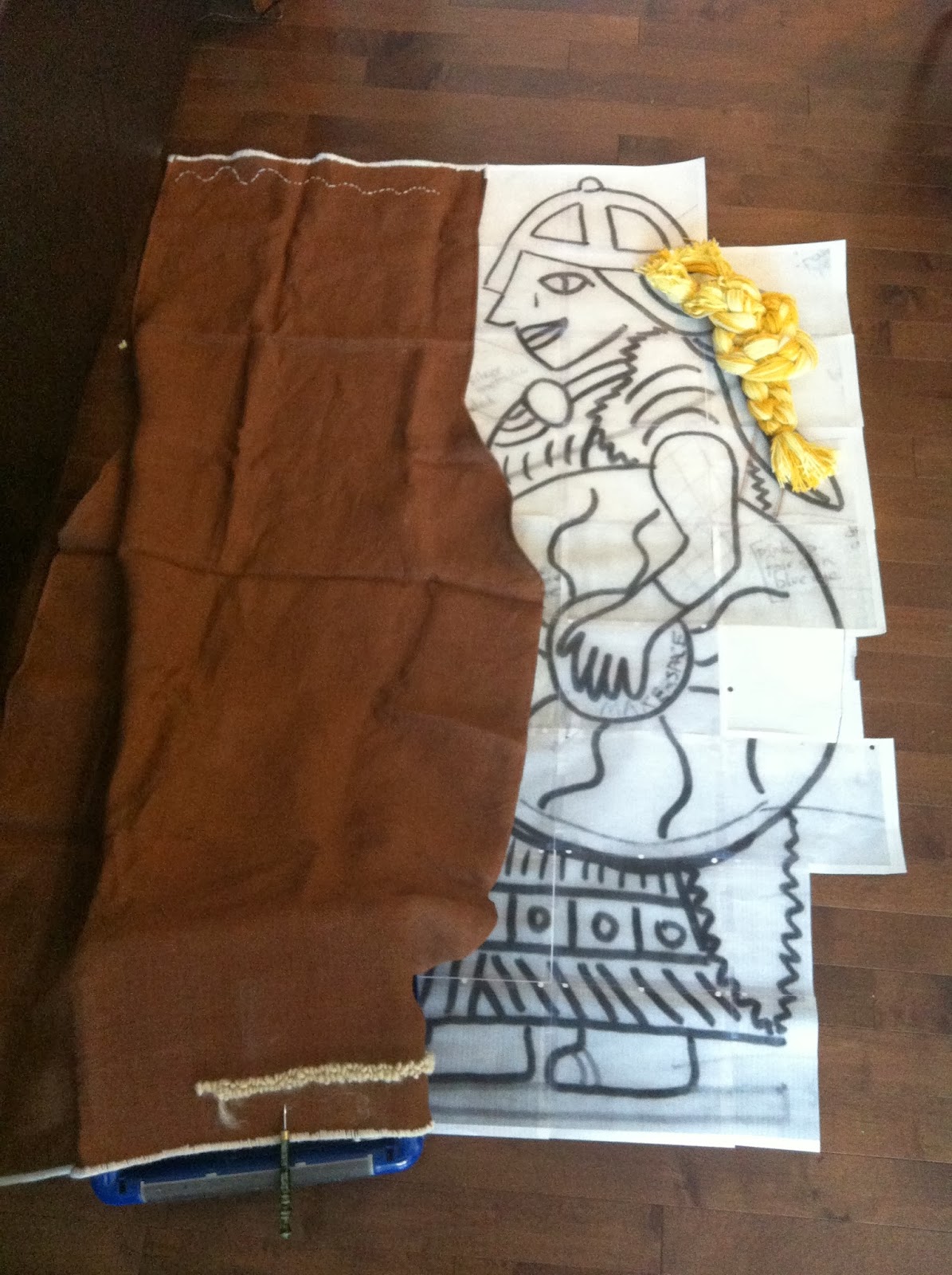
Drawing enlarged to full size to create pattern (which was transferred using interfacing as a substitute for red dot tracing fabric). Jute backing sewn to size, edges whipstitched, and some snow hooked in using wool roving. The braid is a mix of woolen fabric and yarn, made as a four-strand plait then knotted as seen in the original Valkyrie figurines.
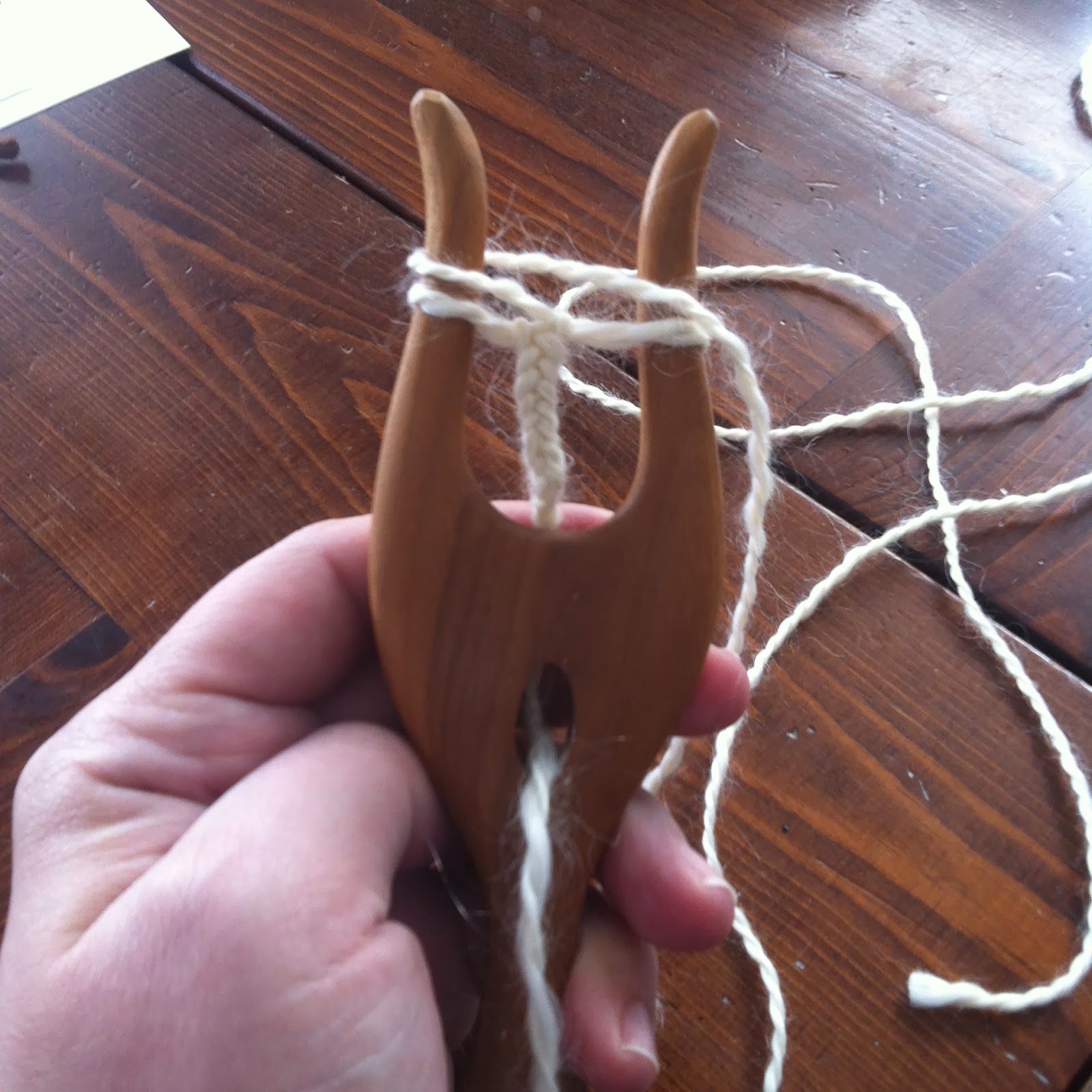
Making lucetted square cord using a beautiful handspun yarn from another local artisan (it's Alliston Findlay's Yeti blend, so lovely to work with). This cord was used for the drinking horn, and similar cord made from a machine-spun pure wool yarn was used for the bowstring.
A length of indigo shibori I made in the surface design course I've previously described, accordion-pleated and sewn - at which point I realized it needs to become the front panel of a skirt for me.
Luckily I had another length of shibori that was much better suited to becoming an apron dress and having the entire middle section covered by a shield. The pleats at the bust really worked beautifully with the large-scale mokume at that end of the fabric. Also, this pale indigo approximates the woad thay would have used during the period in western and northern Europe. The straps and trim are grey woolen fabric that I overdyed to green using acid dyes, in a shade that is also true to period. They were eventually embroidered in a woad blue yarn from Briggs & Little.
Making progress: helm in two colours of felted woolen fabric, braid, skis, and apron dress all sewn in place.

Tearing off the paper pattern after thread-sketching the faux quilting onto the sleeve (Yes, she is m'lady Greensleeves!). This project was my first try at both applique and thread-sketching, although I've been sewing off-and-on since forever.
My final photo at home before the installation. Shield cut out by Marissa and sewn by me after her first attempt went sideways - I love the shimmer and texture that her fabric choices added. The leather boots and needle-felted hands are by Jasmin. Cheesecloth added under the the skirt edge and at the top of the apron dress to represent the linen kirtle, bow and drinking horn in place, details embroidered on apron dress, and the fur cloak is hooked in a mix of fabrics (and not quite complete, but time's up!).
Installed on Alberta Avenue for Deep Freeze Festival 2014. Brooch and beads and needle-felted-embroidered-and-button-embellished face by Jasmin. Face and hair sewn in place by Marissa.  You can also watch a Vine that Marissa made to show all angles of the completed lamp-post cover - well, almost all angles.
Photo via Marissa of our team posing with the completed lamppost cover.
I've titled this post work-in-progress, partly because I actually would still like to do more hooking and add more details to the background, despite it having already hung outside all weekend. (It was right beside one of the firepits, too, so it smells of woodsmoke!) This will probably be on permanent display in the makerspace when it opens, with the intent that people working in the space can continue to add details to it. 


Sunday, December 8, 2013

A Canadian Christmas: mock cherry (cranberry) pie

I have no idea if this recipe is a Maritime food tradition, per se, but my Christmas holidays are incomplete without it, and it features one of the great wild foods of of eastern North America: the cranberry. Regional magazine Saltscapes have printed a version of it, attributing it to author Lucy Maud Montgomery, so I guess it has a little Canadian food cred. My Nana - my maternal grandmother - made it every Christmas, and now so do I.


This time I used organic fresh cranberries grown in Notre-Dame-de-Lourdes, Quebec, and a handful of leftover craisins along with the raisins. You can do this with frozen cranberries too, of course. The recipe from Saltscapes calls for chopped fruit, but I use the cranberries and raisins whole.

Pearl Lantz Schofield's Mock Cherry Pie Filling 

Sunday, November 24, 2013

Pearl Lantz Schofield's Pumpkin Pie recipe, made from scratch


Today we used my Nana's recipe to make pumpkin pie from a wonderful Riverbend Gardens pumpkin that was a gift from my friend Owen. It was scrumptious, although probably not special to anyone outside my family. Here's her recipe:

spice mix:
cinnamon 1 tsp
nutmeg 1/2 tsp
ginger 1/2 tsp
allspice 1/2 tsp
dash of salt

1 egg

1 cup pumpkin (fresh* or canned)

1 cup milk/cream blend
1/4 cup sugar (this amount seems low, don't you think?)
or, substitute 1 cup sweetened condensed milk for milk-sugar mix

Whisk all ingredients together and pour into a pastry pie shell. Bake 375F for 45-60 min, until the filling is firm.

*To prepare a fresh pie pumpkin: cut in half, scoop out the seeds, roast the flesh 350F for 1h, let cool, and puree. For more details (and a delicious-looking fancier alternate recipe!) check this terrific post out. 1 pie pumpkin (the little smooth ones) will usually yield enough for two pies.

Wednesday, November 13, 2013

Fall 2013 Slow News Summary

I'm back to regular life, and gradually catching up on all the writing I've been putting off! I'd like to thank my friends and followers who stuck by me through my foray into covering the municipal election for the Local Good, which we did on the principle that engagement with local politics is consistent with locavorism. I know my twitter and Facebook feeds were pretty #yegvote-heavy from August through October, and I'm sure anyone not in Edmonton who is still following me was muting the hashtag by the end. Here's a summary of what I learned in the process. It was pretty interesting, but I'm delighted to be taking my other interests off the back burner. Speaking of...

On sustainability and environment:

Let's start with the bad news. Arctic sea ice is not recovering. Ice on Arctic islands is melting for the first time in 44000 yearsOver 80% of terrestrial ecosystems are at risk from climate change, and ocean acidification likely means all ocean ecosystems are also at risk - and many marine species are already under intolerable pressure from overfishing and plastic pollution. The global food supply is also at risk from climate change, and National Geographic's interactive sea rise map demonstates that unless we can turn things around, many of the world's coastal cities will eventually end up underwater. The most recent IPCC report (even with revisions) is very clear that climate change is anthropogenic and only drastic cuts in greenhouse gas emissions can prevent unprecedented consequences. The somber tone and stark language being used by scientists trained to speak conservatively with lots of caveats is striking; it brings to mind cold-war-era language around the possibility of triggering a nuclear winter.

So, we have an enormous challenge ahead of us, an enormous responsibility to bear - and an enormous opportunity. The solutions we create as we build our cities and live our lives and move toward a zero-carbon-emissions future will need to be innovative and exciting. Let's do this thing.


An augmented-reality sundial bench by Joshua Barnes, shown at London Design Festival 2013, via designboom. An app allows users to record memories associated with the shadow cast by the dial.
On slow design, slow making, and slow home:

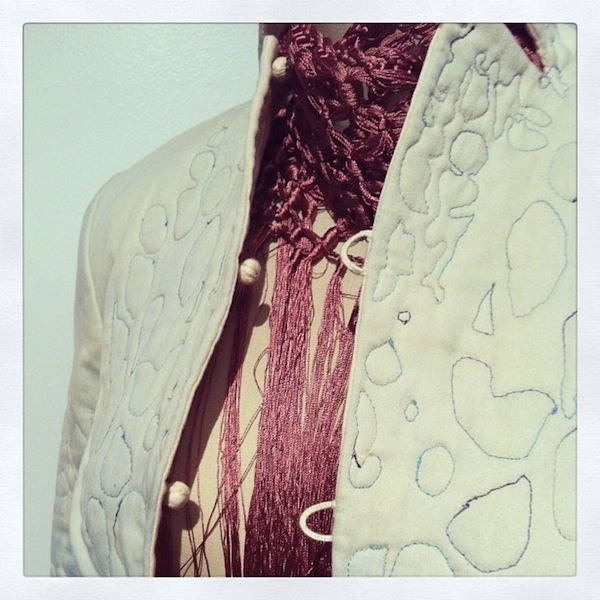
Balmaseda ‘Tafoni jacket’ at the ‘Art of Slow Fashion’ event in New York (photo by Abigail Doan, from her wonderful LOST IN FIBER Tumblr)
On slow fashion:
On slow food:
On slow travel:
On slow living, slow parenting, slow money, and so forth:


Wednesday, November 6, 2013

Harvesting and Preserving: Green Tomato Mincemeat

This post is part of the Canadian Food Experience project (also on Facebook) proposed by my friend Valerie Lugonja, who is a board member of Slow Food Edmonton. The project began June 7th, 2013. As we (participants) share our collective stories across the vastness of our Canadian landscape through our regional food experiences, we hope to bring global clarity to our Canadian culinary identity through the cadence of our concerted Canadian voice. Please join us. 

My October was bananas, thanks to municipal election madness over at the Local Good's blog, so this month you'll get a two-fer: my preserving post and my harvest post, all in one. A childhood harvest memory that I cherish, and hope to recreate next year here in Edmonton, is having such a bounty of tomatoes from my mother's garden that we couldn't possibly eat them all. Usually, Mom planted three different varieties: a cherry tomato for salads, a plum tomato, and one other. I remember the flavours but not the names - I'll have to ask her which cultivars they were (update: Mom says she planted the Beefeater and Scotia cultivars). There would be big brown paper bags of them lined up on the windowsill over the sink, to induce them to ripen, but inevitably we'd need to use them up before they all had a chance to get red. So, it was always my maternal grandmother's Green Tomato Mincemeat recipe to the rescue. It makes a wonderful pie filling, and since there is no actual meat in it, it's suitable for vegetarians and vegans.


Photo via Rhubarb & Honey who shares a very similar recipe!
Pearl's Green Tomato Mincemeat

3 pounds (10 cups) green tomatoes
3.5 pounds apples (Gravenstein apples would have been used)
2 cups brown sugar
1 pound seeded raisins
1 pound seedless raisins
1 tbsp salt
1/2 cup oil
1/2 cup cider vinegar
3/4 cup apple juice
2.5 tbsp cinnamon
2 tbsp cloves
1 tbsp nutmeg
2 lemons, grated and juiced

Cut tomatoes in quarters and blend; drain.
Add chopped apples (not peeled!) and other ingredients except lemon juice.
Cook slowly 2-3 hours adding apple juice as required.
Add lemon juice just before bottling.
Can be frozen or canned.

(Sorry, no photo - I haven't had a chance to make this yet! I'll edit this post to add photos as soon as I can, but I wanted to share the recipe right away.)

PS: Oooh, look, Valerie posted her green tomato mincemeat recipe too, with the most mouthwatering photos. Her proportions and spices (candied ginger!) are a bit different from my Nana's, be sure to compare them!