Tuesday, May 1, 2012

Ten Easy Ways To Take Life More Slowly

{This blog post is adapted from the talk I gave at the 2012 Millet Womens' Retreat on March 10th, and reposted from my guest post yesterday at Edmonton's NextGen. I was so honoured to be asked to contribute, given all the amazing work NextGen do. I didn't quite succeed in whittling a half-hour talk down to 1000 words, but it was fun trying.}


Another Earth Day, another avalanche of press releases and sales flyers. Sometimes it feels like 'green' has become another hokey sales pitch for gadgets you don't need, doesn't it? However, Earth Day is more than just an opportunity to get a great deal on a rain barrel at the hardware store. It's a chance to rethink how our everyday actions have an impact, not just on the planet, but closer to home.

This is what Earth Day is actually about. Earth & Moon as seen from Mars
(3 Oct 2007, HiRISE camera, NASA’s Mars Reconnaissance Orbiter)
 
Want to make your impact on the planet and your community a positive one? Try slowing your life down.

By 'slow', I mean the opposite of 'fast' as in 'fast food' and 'fast fashion'. The Slow Movement is a worldwide grassroots initiative that seeks to mitigate some of the negative effects of consumerism and globalization on communities and traditions, using mindful, ethical, interactive, and playful means. It's a philosophy that's being adapted to many different subjects, including slow foodslow fashionslow designslow homeslow travelcittaslow (slow cities)slow craftslow marketingslow parentingslow scienceslow journalism, and slow technology

At its heart, the Slow Movement is about making choices that support communities and celebrate their traditions and skills. Here are ten easy ways you can incorporate its ideas into your life.


1. Local Is Lovely

Thinking locally is the most important idea behind the Slow Movement. Consciously choose to shop, eat, bank, and use services in your community. Seek out things that are grown or made locally, and support local independently-owned businesses. Live Local are Edmonton's best resource for shopping, dining, and eating locally, and they've written a great explanation of why choosing local makes a big difference. 

2. Think Sustainable

Yes, being green is part of being slow, because sustainable practices build healthier families and communities. The emphasis in the Slow Movement is less on eco-marketing buzzwords and energy efficient gizmos, and more on doing what you can with what you already have. There are lots of easy, inexpensive ways to make your home and life more environmentally friendly. A couple of strategies that can make a big difference are looking for third-party certifications to back up a manufacturer’s sustainability claims, and thinking about a product’s life cycle (How and where was it made? Was it shipped far? How long will it last? Does it offgas? What happens when you're done with it?).

3. Think Long-Lasting

Choose to buy things that are durable, timeless, and well-made. If you consider the life cycle of an object, something you will use and love for decades beats out something you won’t, no matter what other eco-attributes it has. So, aim to buy fewer, better things – and go ahead and eat off the good china.

4. Sharing Is Caring


Borrow from your neighbors. Use your local library. Rent tools instead of buying them. Join a car sharing group. Barter, trade, and swap. All these ways to share items aren't only cheaper than ownership; they’re also a great way to reduce your personal environmental footprint and build community. Collectively, these activities are referred to as Collaborative Consumption, and peer-to-peer services that use sharing as their business model are exploding in popularity all over the world. 

5. Less Is More

Voluntary Simplicity and Minimalism are twin strategies for slow living. Minimalists aim to buy less, higher quality stuff, and say that living with fewer things is freeing, in addition to being more environmentally friendly. The term Voluntary Simplicity tends to be used by people who aim to live frugally and self-sufficiently.

6. Make Do And Mend
Fixing things – and buying things that are designed to be fixable, instead of having planned obsolescence – is sustainable behavior, but also helps us to learn new skills and share skills with each other, and we tend to cherish objects that we have mended with our own hands.  

7. Wabi-Sabi

Wabi and Sabi are concepts that come from Japan's Zen Buddhism. The concept of wabi includes harmony, balance, simplicity, and humility; sabi translates literally as "the bloom of time". Taken together, the words describe the beauty of everyday, functional objects that we cherish because they are well-used, patinated, handmade, and tied to memories. Wabi-sabi is also living in the moment, simply and authentically, and letting seasonal rhythms and local availability influence our lives. 

8. Think Handmade
9. Think Traditional 

These two ways to slow down your life go hand-in-hand. If a goal of the Slow Movement is to protect regional cultural traditions from globalization, industrialization, and consumerism, then it follows that passing on the traditions that you grew up with, and learning more about the traditions of your region and your ancestors, is an important part of slow living. When I think of the traditions I know of from my family that are no longer celebrated, they all have to do with making things by hand that are mass-manufactured now – like hand-quilted blankets and recipes with days of soaking time. There are countless hand-making skills and family recipes that I cannot learn easily from family members now that I live in another province – I need to turn to books and blogs and YouTube videos to figure them out. Not much is handmade any more, so to preserve those skills and traditions we need to support the artisans who are using them, and learn the skills when we get a chance.

The flip side of that is the intrinsic value of living with handmade things – their beauty and their durability. Just knowing an object is made by hand makes it more special, even if it doesn’t come from our personal set of traditions. Knowing who made something and where it was made makes it even more special.

10. Take Your Time

Try literally slowing your life down. That could mean doing things more slowly and carefully, to get a higher quality end result. It could mean saying no to things that are not a priority for you, to make room in your life for your passions. It could mean taking a sabbatical to research a new area, taking a course to learn a new technique, or taking time off for a vacation, to help inspire new work.

As you can see, incorporating the ideas of the Slow Movement into your everyday life could make it more beautiful, meaningful, sustainable, and connected to your community.

Tuesday, April 24, 2012

Three Things I've Learnt This Month

Six days 'til possession, and I have moving on my mind.

1. A great decluttering strategy. Anything you'd rather pile in the backyard and burn, than pack and move a few measly blocks? Donate it to charity, or throw it out. Be utterly ruthless. (Unfortunately this strategy cannot be applied to your young childrens' mountain of stuff without tears.) We're renting a dumpster from a local company who will take care of making sure anything that can be recycled does get recycled, and I've made a ridiculous number of trips to drop off bags of donations.

2. Green moving strategy: we're going to rent sturdy plastic moving boxes for a couple of weeks. FrogBox is the local option for this, they have franchises in many other North American cities, and their rates are very reasonable (as in, actually cheaper than buying cardboard we'd have to recycle after the move). We also have purchased a number of clear plastic bins that I'm labelling and using for longer-term storage.

3. Moving house would be much, much easier if I were a minimalist - but I'm not sure it would be any less stressful. When the experts say it's as big of an emotional upheaval as a divorce or a job loss, they really aren't kidding.

There's also some great advice in this post on moving from GOOD. We did, in the end, decide to hire movers instead of going the full DIY route, although we plan to use and reuse our rented boxes to move most of the little things before the movers arrive.

BTW, there will not be a monthly news summary for April - there will be an extra-big one in May instead. Meanwhile, as always, you can watch my Twitter feed for interesting tidbits from the vanguard of the slow movement.


Wednesday, April 18, 2012

Dream Decorating: Kitchen - Dining - Family Room

It's about two weeks before we take possession of our new home, and I'm procrastinating about the much-dreaded packing-and-purging by planning the decor. (Is it normal to want to set fire to all your stuff instead of packing it at this stage? Please say yes.) Let me tease you with some product shots of what I'm planning to use in the kitchen, dining room, and living room, which are open to each other.


Here are a couple of before shots I took during the home inspection.

via Benjamin Moore Colors on Flikr
Eternity in eggshell on the wall in a blog post by Urban Domesticity
The first thing that will happen is that the builder beige will be painted out. We will also play with adding moldings to the existing trim to make the house feel vintage-Craftsman instead of faux-Craftsman. Much as we'd love to paint while the house is still empty, the seller is still in another country and not responding to our request for permission to take painters in so they can give us quotes. Sigh.

So, we'll have to paint after the move, and meanwhile I've been pre-testing samples of grey paint, using the similar light in my current home. I think pulling out the grey and playing down the yellow-beige in the stone fireplace surround, granite counters, and ceramic tile backsplash with a grey wall is the way to go. However, greys are tricky - they look perfect as a colour chip, and then you get it onto your wall and the undertones emerge, or the character switches from cool to warm because it's a bit too brown. After looking at the range of greys from multiple manufacturers, I've decided to try Benjamin Moore's Natura 0-VOC paint in Eternity for the walls, and Steam (an off-white) for the ceiling and trim - I'll know for sure once I get to test it in the space. Eternity is a true grey with the smallest hint of blue. A paler true grey for spaces that don't get as much natural light might be Horizon.

(I had really wanted to use uber-eco Mythic Paint, but our local dealer here in the wilderness of Canada doesn't have the ability to accurately create smaller testers with equipment calibrated for full-size cans, so that will have to wait for another room where we won't need to test the colours. Dear Mythic: please make your tester pots available through your Canadian vendors. One cannot specify colour using only a tiny chip on a fan deck. Ever. Seriously, get on it.)

19th Century French Farmhouse Table  furniture
Our dining table is pine with a walnut stain in a shape very much inspired by French farmhouse tables like this one, the genuine c1860 article from Uniquities Architectural Antiques in Calgary (via Houzz). It came with Parsons chairs and a matching bench upholstered in sensible espresso faux-leather. When the kids are a little older, I'll have them reupholstered in something fabulous.


Here's an old photo (of my daughter's third birthday party) from our current home's dining room. The vintage English walnut china cabinet will also make the move to the new house, and I'm hoping we'll be able to bring our pendant lamp with us as well, since it would suit the neo-Craftsman architecture much better than the current one does.

We have a hard-wearing, kid-friendly roll-arm brown leather sofa from Lane (the Wakefield) that my kids are doing their best to patinate for me. Fabulous cushions and a great throw will help to make it less of a yawn.


Since the kids will have another space that acts as their playroom, I want a tempered-glass coffee table, and originally I was thinking of a waterfall table or this 'Osaka' coffee table from Urban Barn - it's very similar to one available from US retailer West Elm. I've since scored a round one with a chromed base off Kijiji for a song, which will do nicely as a placeholder, and will be perfect for staging our old house. Unfortunately I don't have a photo of it yet. Inside my head, I'm rounding this out with Brent Comber's alder drum table and one of Jasper Morrison's cork stools, but I have a feeling our budget won't stretch that far, so I'm on the hunt for some sweet vintage end tables to add to the mix. There's an Aalto-esque tripod stool and a Mission-style octagonal table at the antique mall that might make the cut.


With all that stone, wood, and leather, the space will need an injection of femininity and softness. I've ordered FLOR's Reoriented recycled-nylon carpet tiles in Lavender; there are also touches of cream, grey, beige, sky blue, and indigo blue in the pattern, as you can see in the detail shot. With the glass coffee table you'll be able to really see the rug so it needed to be fantastic, and this pattern is a great riff on the overdyed-oriental trend. I already have faux-silk curtains similar to these, in aubergine, which I'll hang over the existing wooden blinds.

mid-1920s Poole Pottery Traditional majolicaware, via Rob's Poole Pottery Collection
1940s Poole Pottery's Traditional majolicaware, via Poole Pottery Replacements
I have a small collection of Poole Pottery that I'll be displaying in the room (It reminds me of my paternal grandmother, who used to have a huge collection of it.). Notice that the lavender is picked up in Poole's glaze palette. I might also pull out this vintage hooked mat from storage to hang as part of the art wall. (The long wall that's continuous with the stairwells is begging to be used as a gallery.)


Let's see, what's missing? Stools for the breakfast bar - I just scored a perfect match to the old farm stool I already had, so I'll be using those, at least until I can work some Emeco Navy bar chairs into the budget. A big leafy plant or two. Books, naturally. Our antique mirror and the mantle clock handed down from my husband's family for over the fireplace. A great floor lamp or two, and improvements to the ceiling fixtures (all of which I dislike). And a way to deal with the television my darling husband is insisting we put in there... any suggestions?

Thursday, March 22, 2012

Slow Home: Do You Know Your Home's History?

One of the central goals of the slow movement is to foster a sense of community and connection, and researching the history of your home is a great way do that. Here's a case study on how to go about it, using the house my husband and I just bought. I thought it would be fun to show that even a relatively new home can have a history worth looking into!

If you live in an older house, you may find the tips and resources in the "Be your own House Detective" articles in the October 2010 and November 2010 issues of UK genealogy magazine Family History Monthly very useful. There are also great resources at the UK's National Archives and Bricks and Brass, and at Active History (for Canada) and the cities of Edmonton and Calgary - try adding your municipality to the search terms 'researching history of house' to find relevant resources for your area.

{Step 1: Write down what you know about your home's previous owners, builder, architect (if any), location, and prior land uses.}

Our new house was built in neo-Craftsman style in 2008 by Alberta-based builder Homes By Avi, as a  spec home using their "McCullough A2" plans (according to the builder's records; the MLS listing had it as a former showhome). The subdivision in which it was built is new enough that when we moved to our current home in an adjacent subdivision in 2001, the land was farmland used for growing canola and wheat, and deer and the occasional moose were routinely seen grazing along the road. It is still an active construction zone with only about a third to a half of the lots completed. The land is adjacent to a ravine that has been designated a wildlife refuge, called MacTaggart Sanctuary. A lovely unpaved walking path winds through the Sanctuary along Whitemud Creek's wooded banks past an active beaver colony, and the path connects to paths through our city's river valley and comprises part of a huge hiking trail network called the Waskahegan Trail

I snapped this photo from the edge of a beaver dam in MacTaggart Sanctuary last October.
Nearby there was a trail of flattened grass on the bank, where the beavers like to slide into the creek.
{Step 2: Look for documentation and clues to the house's former life outside and inside the home.}

We don't yet have possession of the home, but I took lots of photos and measurements during the house inspection, and we will take another look once we are in. We don't expect to find much, since the property was built so recently - but in an older home, the architectural style and changes to the layout as the home has grown additions or suffered renovations can give important information about its date and past. So, taking measurements and drawing up your house's floorplan can yield clues. When we compare our home to the current version of the floorplan linked above, we see a number of changes: the entire second floor is different (with 3 larger bedrooms and a media room, instead of the four bedrooms shown in the PDF), and a hallway was closed off and space stolen from the front room to add a shower stall to the powder room and a closet to a home office suitable for seeing clients. Those changes and the slightly worn builder-beige paint throughout this house are consistent with the information from the MLS listing that it was a showhome before it was lived in.

A quick, rough sketch of the house's actual floor plan, not-to-scale.
Modified from the current version of the McCullough marketing materials on the Homes By Avi website.
{Step 3: Look for further information that is part of the public record. Start with online searches, then check with the local archives for your city, county, and province (or state). Don't forget to look at the websites of community organizations and local newspapers, as well as local histories, maps, surveys, and census records for heritage homes.}

Here is what I found out:

- By searching on the street address, I found the website of a business that was run from the home office of the house, and the name of a previous owner.

- By searching on the name of the subdivision, I found the marketing materials for this subdivision and the one next-door, information about adjacent model-green-community subdivisions, the city's neighborhood profile and Neighborhood Area Structure Plan (PDFs), and an article for the local community league's newsletter about the history of the subdivision (on page 18 of the PDF). The city's plans call for this to become a highly walkable mixed-density neighborhood.

- From the Neighborhood Area Structure Plan, I learnt that there once were coal mines on the north bank of the creek, and as a result a larger buffer zone than would usually be needed is required around the ravine. This makes for nicer park areas on the upper edge of the ravine. Googling told me that the development on the other side of the ravine (Twin Brooks) is on the site of a former mining village, traces of which can still be found in the subdivision. So I'm guessing that the miners who dug the mine shafts in the ravine lived there.

- From the newsletter article, I learnt that the farm and ravine had belonged to Walter Street, who had retired to a one-room cabin overlooking the ravine, and that Maclab Enterprise's Sandy Mactaggart bought the land from him (after years of conversation) with the promise that he could continue to live there, and that the ravine would become a nature reserve. Mr. MacTaggart made good his promise and arranged for the land, along with adjoining land owned by the Province, to be donated to the University of Alberta as a nature reserve.

- I also learnt a fair bit about the colourful, community-spirited Mr. MacTaggart who bought Mr. Street's farm and ravine from him. Anyone who lives in Edmonton is likely familiar with the development corporation that Mr. MacTaggart was a partner in, but the many new residents of our rapidly-growing city might not be aware of the large role he and his wife played in both building Edmonton's inner-ring suburbs and cultural community (I've lived here going on eighteen years and had not been aware of his work and legacy). I do think it's fitting that the nature reserve and the new neighborhood on its edge are named for MacTaggart.


- A sign (in the photos above) at one of the entrances to the MacTaggart Sanctuary from the new neighborhood of MacTaggart confirmed the newsletter story, and added a few crucial clues to Walter Street's identity: that he lived 1878 - 1969, that he fought in World War One, and that before his retirement to farm the land beside Whitemud Creek Ravine, he had managed the stable at the Edmonton Ice Company.

- I found Walter Street listed in the 1950 Henderson Directory for Edmonton, occupation "stableman Arctic Ice Company" (who bought out Edmonton Ice Company), living at a Rossdale address near (or perhaps in) the Arctic Ice building at 100 Street and 97 Avenue; by 1952 he had moved and is no longer listed (although a carpenter of the same name is).

- A search on Walter Street, Edmonton, Alberta on Ancestry.ca led me to census records of two possible individuals, one of whom was married (and seems to be the carpenter I just mentioned) - and the other of whom is too young to be the correct individual, if the signage placed in the community is correct, but who otherwise seems to fit the facts. I'm now corresponding with one of the people researching that Walter Street's family tree, and have promised him I'll make enquiries at the local archives to see what else we can learn. Using the dates from the signage instead of a location in Edmonton has suggested a few other possible individuals, so I will need to find more information in order to narrow down the origins of the Walter Street who farmed the land my house now sits on, regardless. My next step will be to visit the archives, in person.

Walter Street's name ought to be more widely known, since his foresight and generosity ensured that his land on Whitemud Creek was preserved in as unspoiled a state as possible for us all to enjoy. I hope he would approve of the beautiful wildlife sanctuary and the neighborhood being built on its banks.

Monday, March 19, 2012

Monthly Slow News Summary: March 2012


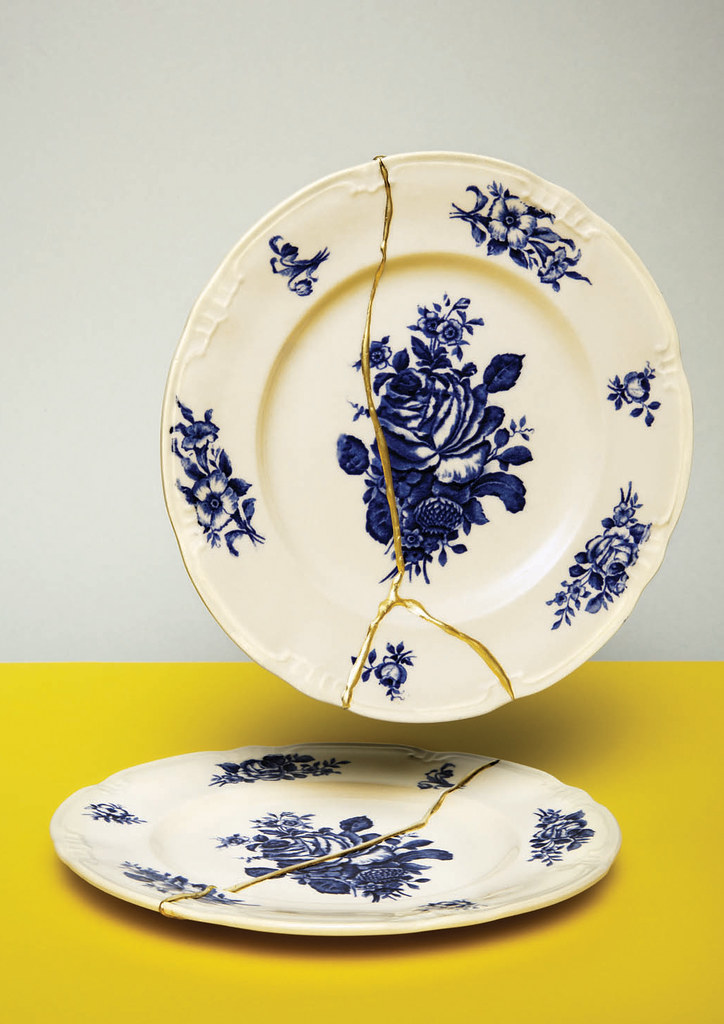
Remember the modern version of kintsugi developed by artist Lotte Dekker for Platform 21's repair exhibit (photo via Ars Electonica's Flikr feed)?
She's selling kits now through her company 
humade, and there's a fab video on ifixit.org.
Project Sugru also 
took a photo of the kit at a Makerfaire in the UK last year.
I wonder if the epoxy is food-safe, or if the repaired plates would be purely decorative?
On Slow Design and Slow Home:
  • Irene Turner has been exploring how 'Cultural Creatives' are creating trends in the housing world. (Sarah Susanka has blogged about this demographic's relationship to their homes, too.) The slow movement, a holistic approach to building design and decor that encourages collaboration between different disciplines, right-sizing, renovation, restoration, green building, and community-building are all trends Irene discussed. I think what we're seeing is that the core values of the slow movement are core values of Cultural Creatives: authenticity, community, ethics, and sustainability.
  • GreenBiz, reporting on a USGBC report, asks, are green buildings safer and more resilient than conventional construction?
  • I'm a big fan of Philips' new dimmable AmbientLED bulbs as the current best-in-class energy-efficient replacement for incandescent bulbs; I've tested one at home and the light it gives is gorgeous, with great colour rendition. However, Tea-Party-affiliated media are running with erroneous talking points and attacking it, Treehugger reports (with the correct energy usage and savings figures). Do you think Philips have a case to sue them?
On Slow Fashion:
On Slow Food:
  • Grain Barge in Bristol, UK are now doing Slow Food Dating events. What a thoughtful twist on speed dating, and a great way to promote slow food in a restaurant setting!
  • “Leaving the table is like leaving a lover. It should be slow." - A meditation on the importance of beautifully set table and other meal-time rituals in Italian culture from Peggy Markel has me renewing my resolution to get a great linen tablecloth and napkins for everyday use.
  • Ever tried eating your weeds? Sustainablog rounded up harvesting tips and 7 recipes for using dandelions.
  • Grist published an important piece on proposed and passed bills in several states that legalize the sale of home-made foods. Hey Canada, do we have cottage food bills yet? No? Let's get on it.
  • Here's a great piece from Slow Food Toronto's Voula Halliday on explaining Slow Food as an elevator pitch.
  • I'm struggling with a kid who doesn't like his food to touch his other food, and refuses almost anything with spice, so I so need to implement the advice in this fantastic article from Dina Rose: Food Culture and What It Means to be "Child-Friendly".  
  • EcoSalon have posted a list of 20 genetically modified foods currently or soon to be for sale. Fascinating reading, and relatively balanced, compared with many of the ridiculously alarmist scare stories I've seen recently. 
Droog used these clever bread boards to stimulate discussion of locavorism at their "Go Slow Cafe"
in New York in Sept 2009 - and the discussion is still ongoing thanks to Pinterest.
Photo by Raphael Brion via Eat Me Daily.
On Slow Living:
On Slow Travel:
On Sustainability:

Tuesday, March 6, 2012

Introducing our new Slow Home

So, we bought a house!

exterior - yes, we just had a snowstorm
living room natural-gas fireplace with stone facing
detail of rail at top of stairs in bonus room
kitchen granite counter and backsplash
one of the small square windows, to show the neo-Craftsman millwork
ensuite tub, showing the maple cabinets and tile used throughout the house
oak floors with a nice dark stain
I took a few photos during the home inspection today. I've tried not to show the current furnishings, out of respect for the prior owner. (I'll share more photos once our stuff has been moved in. Promise.) The house has a bad case of builder beige, but good bones, don't you think?

As you can see, the exterior and interior trim is suggestive of Arts-and-Crafts style, as is the case in several of the new subdivisions being built around Edmonton - and in many other cities, based on what I am seeing online. As a Prairie city that had its first real growth between the World Wars, Edmonton's most coveted central neighborhoods are streetcar suburbs filled with Craftsman bungalows and Four-Squares - many of which were mail-order houses. I once read a reprint of a 1930s Sears kit home catalogue, and it was amazing just how many of the illustrated exteriors were instantly recognizable as homes in Glenora and Strathcona. It makes sense that they'd be mimicked by builders looking to trade on the style's cachet, for buyers who want the look in a larger, newer, less expensive home in the outer-ring suburbs.

So, we'll work with that style, and add Craftsman-style interior trim, built-ins, and hardware (and fix the existing trim, which is a bit too simple and looks clumsy as a result). That will help to add architectural interest and a sense of history to the interior. At the same time as we do that, we'll try to slow down the design of the house, which we score (generously) at 14/20 on the Slow Home Test. Making the home more environmentally friendly, adding better lighting and more built-in storage, creating a proper garden, and giving the neighborhood time to mature and develop more nearby amenities (which are still under construction) will all help to improve that score. It'll never be a 20/20, given its suburban location and total lack of attention to the sun's path and the prevailing winds, but it's "somewhat slow" and it meets all the criteria that I laid out in a recent post.

I'm pleased that the home is faux-Craftsman instead of one of the other styles that are currently en vogue. The Craftsman aesthetic is very in tune with modern Slow Design sensibilities, with an emphasis on honest use of natural materials, connection to nature, artisan workmanship, and human scale that was originally borne of protest against industrialization and mass manufacture. In practice, the kit houses and the furniture and wallpapers and tiles used to decorate them were mass-produced in one of the first examples of democratization of design, and they were marketed by the kit-sellers as modern, luxurious, efficient, hygienic, and convenient. Craftsman bungalows borrowed from traditional Shaker, Japanese, and Bengalese architecture, and featured rooms that were open to one another, an abundance of natural light and natural wood, and the use of art tiles and art glass as durable decorative flourishes. Thoughtfully-designed built-in furniture was used to increase the apparent size of the rooms and to keep the rooms easy to clean. An emphasis on long horizontal lines, square motifs, and simplicity of form makes the architecture read as fairly masculine, which is usually balanced by adding rounded forms in the furniture and lighting, and adding decor showing Art Deco and Art Nouveau influences. (Here's a detailed article discussing Arts-and-Crafts architecture and interior decoration in Nebraska - most of what the author says is also true in Edmonton.)

There are lots of great resources out there for families who are restoring their Craftsman homes, and if I really wanted I could pull out all the stops and make this house as authentic as I wished using those resources. I will not be going with a slavish reproduction of Craftsman style in our new home, but I will let its aesthetic inform the architectural millwork and hardware choices we make. I've started by creating a pinboard of Craftsman reference images (naturally). We take possession at the end of April, so I have about two months to pack and plan things before the move. This should be fun!

Tuesday, February 28, 2012

Slow Home Househunting: Better Not Bigger

I know, I know, it has been forever since I've posted. I've been busy with some other projects, and the big news is that we are house-hunting again, which is time consuming and not ideal blog fodder.

Why move? Much as we love our home, the two-up-one-down arrangement of the bedrooms in our multi-level-split really does not work so well when you have two young children. Neither does our floorplan's disconnection of the backyard from the waking-hours parts of the house, which makes it hard to watch kids playing outside, or barbeque, or entertain. So we're looking for a new place with a more suitable floorplan. We like our neighborhood, an island of walkability with new schools and groceries within an easy bike ride, but unfortunately our in-demand new-urbanist subdivision doesn't have many houses available that will meet our needs. So, we've stretched our search into the neighboring subdivisions (which are also quite walkable, and closer to the protected natural areas in the North Saskatchewan River valley and the Whitemud Ravine) and held our noses over the garage-mahal-ness of most of the views from the curb while we look for the right house.

Our criteria for a suitable slow home for us:
- it has to have at least 3 bedrooms on the same floor, and a 4th space that can act as a guest bedroom when family come to visit from Nova Scotia
- it has to have either large bedrooms or a separate playroom for the kids (who are now old enough to need some privacy while they play)
- it has to have easy access to the backyard from a kitchen - dining - family room area
- it has to have a well-designed kitchen for baking (you'd be amazed how many houses we've looked at that have kitchens with no decent work triangle)
- it has to be enough of an upgrade (in interior finish quality, not in square footage) that it's worth the trouble and expense of moving - although I have discovered that when push comes to shove, more square footage makes a home a 'better investment' and that weighs heavily for my husband
- it has to have a yard suitable for gardening, and we'd prefer some solar exposure so panels can be installed someday
- it needs to be reasonably energy and water efficient, or easily renovated to be made so (Aside: I have learnt during viewings that, locally at least, third-party certifications such as BuiltGreen are viewed by real estate professionals as adding marketability, not investment value, to a home. I wonder how we can turn that around?)
- it needs to not ring too many alarm bells on Slow Home Studio's Slow Home Test checklist
- it needs to (including any immediately needed renos) fit into our budget

So far we have seen what feels like dozens of houses, and seriously considered an early-80s bungalow with sunken living rooms (too much work needed, and the yard was too shady), an almost-new home that backed out onto a park (the kids' bedrooms were too tiny to grow with them), and an early-90s former show home with a ridiculously huge cathedral-ceilinged great room (that had low-e window film that made the whole interior look violet, and would be a substantial investment to scrape off and replace). We ended up deciding to bump up our budget a bit, and now are looking at two almost-new homes built with lots of energy efficiency features that check all our boxes. We've put an offer in on one of them, and are waiting to hear back from the seller. Wish us luck!